7 Card Blackjack Rules: How to Play British Blackjack?
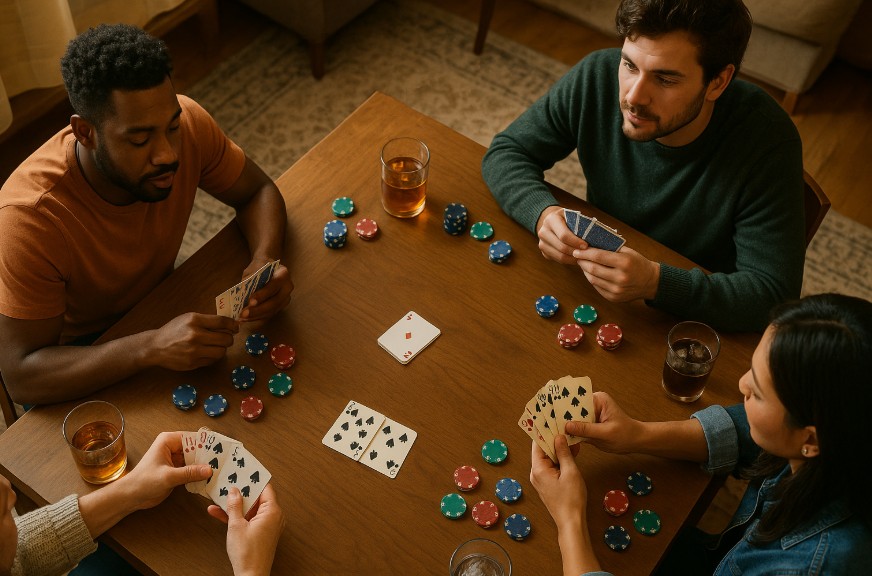
7 card blackjack rules are very different from the blackjack played at casino tables. British 7 card blackjack is a card-shedding game where each player starts with seven cards and tries to get rid of them before everyone else.
Players normally match the suit or rank of the card on the discard pile, while special cards can force opponents to draw, miss turns, change suit or reverse the direction of play.
There is no target of 21, no requirement to beat a dealer and usually no betting involved.
Because British blackjack is commonly played using house rules rather than one official rulebook, players should agree on special cards, Queen rules, multi-card combinations and penalties before the first round begins.
What Is 7 Card Blackjack?
7 card blackjack, sometimes called British Blackjack or simply Black Jack, is a social card game in which players attempt to empty their hands.
Each participant normally receives seven cards. The undealt cards form a face-down draw pile and one card is turned face-up to begin the discard pile.
Players then take turns placing cards that match the suit or rank of the card currently showing.
For example, if the top card is the 6 of Hearts, a player could normally play:
- Any Heart
- Any 6
- An agreed special card that overrides normal matching rules
If no legal play is available, the player draws from the central deck according to the group’s agreed rules.
The first person to dispose of every card wins the round.
How Is 7 Card Blackjack Different From Classic Blackjack?
Despite sharing a name, British 7 card blackjack is fundamentally different from casino blackjack.
Traditional blackjack is based on building a hand towards 21 and making decisions such as hitting, standing, doubling and splitting. British blackjack instead focuses on matching cards, reducing the hand and using special cards against other players.
| Feature | Classic Blackjack | 7 Card Blackjack |
| Main objective | Beat the dealer without exceeding 21 | Discard every card |
| Dealer opponent | Yes | No |
| Starting cards | Normally two | Seven |
| Card values | Important | Usually irrelevant |
| Suit matching | No | Yes |
| Special power cards | No | Common |
| Multiple-card combinations | No | Possible under many rules |
| Betting | Core part of casino blackjack | Usually absent |
| House rules | Set by casino/game | Often agreed by players |
This distinction is important because someone searching for 7 card blackjack rules may otherwise assume that the game involves making a seven-card hand worth 21. It does not.
How Do You Play 7 Card Blackjack?
Shuffle a standard 52-card deck and deal seven cards to every participant.
Place the undealt cards face-down in the centre to create the draw pile. Turn the top card over next to it to begin the discard pile.
Play normally starts with the person to the dealer or shuffler’s left and continues clockwise unless an agreed special card changes direction.
On each turn, the player attempts to match the card showing on the discard pile by either rank or suit.
For example, if the top card is 9♣, a player could normally place:
- Another 9
- Any Club
- An Ace if Aces are being used as unrestricted suit-changing cards
- Another legal special card allowed by the group’s house rules
If the player cannot make a legal move, they draw from the deck.
Some groups allow an ordinary drawn card to be played immediately if it is playable. Others treat drawing as the end of the turn. This is another rule worth agreeing before play begins.
Can You Play Several Cards In One Turn?
Many versions of British blackjack allow combinations rather than limiting players to one card.
There are two important forms of multi-card play.
Matching-rank combinations allow cards of the same number or rank to be placed together.
For example:
5♣ → 5♠
Some versions also allow a player to extend the combination using a sequential card of the same suit.
For example:
5♣ → 5♠ → 6♠
A longer same-suit sequence may also be permitted where each card is one rank higher or lower than the previous card, depending on the house rules.
For example:
7♥ → 8♥ → 9♥
This is slightly different from simply chaining cards whenever either the suit or rank happens to match. Under the stricter sequence rule, consecutive cards of the same suit form a recognised run.
Because allowing long combinations can dramatically shorten a player’s hand, the table should decide before starting whether these sequences are permitted.
What Happens If You Cannot Play?
If there is no legal card in the player’s hand, they normally pick up a card from the draw pile.
Whether that newly drawn card can immediately be played depends on the version being used.
It is useful to distinguish this situation from drawing cards as a penalty.
If a player has been forced to collect cards because of a 2, black Jack or another penalty card, many versions do not allow that player to play immediately afterwards. Once the penalty has been collected, their turn ends.
That prevents someone from taking a five-card penalty and immediately escaping it by playing one of the cards they have just received.
What Happens When The Draw Pile Runs Out?
A long round, particularly one involving several players or heavy draw penalties, can exhaust the face-down deck.
The game does not need to end.
Leave the current top card of the discard pile face-up so everyone knows which card must be matched.
Take the remaining cards underneath it, shuffle them thoroughly and place them face-down as the new draw pile.
Play then continues normally.
For groups of five or more players, combining two standard decks from the beginning can reduce how frequently the draw pile needs to be rebuilt.
What Are The Special Cards In 7 Card Blackjack?
Power cards are one of the features that make British blackjack different from an ordinary matching game.
There is no official nationwide list that every group must use, but the following rules are common.
2 – Draw Two
Playing a 2 normally forces the next person to draw two cards.
If that player also has an eligible 2, many versions allow them to play it instead of taking the penalty.
The penalty then accumulates.
For example:
- First 2 = Draw 2
- Second 2 = Draw 4
- Third 2 = Draw 6
- Fourth 2 = Draw 8
The first person unable to continue the chain must collect the full accumulated penalty.
Under rules where penalty draws end a turn, that player cannot immediately play one of the cards they have just collected.
Black Jack – Draw Five
The black Jacks are:
- Jack of Spades
- Jack of Clubs
A black Jack commonly forces the next player to collect five cards.
Another black Jack may be used to continue the penalty, potentially increasing it to ten or more cards.
This makes black Jacks particularly powerful late in a round when another player is close to going out.
Red Jack – Cancelling A Black Jack
Red Jacks are commonly defensive cards.
These are:
- Jack of Hearts
- Jack of Diamonds
Under many British blackjack rules, a red Jack can cancel a draw penalty created by a black Jack.
Some groups require the red Jack to match particular conditions or suits, while others allow either red Jack to cancel the penalty.
This should be settled before the first deal.
8 – Miss A Turn
An 8 commonly makes the next player miss their turn.
If a player immediately before someone with only one card remaining holds an 8, it can therefore be useful for preventing that opponent from finishing.
Some house rules also allow multiple 8s to be stacked.
10 – Reverse Direction
A 10 commonly reverses the direction of play.
If turns are moving clockwise, play switches to anticlockwise.
If another reverse card is later played, the direction changes again.
This mechanic matters much more with three or more players than with two.
7 Or 10 – Which Card Reverses Play?
There is no universal answer.
Some British blackjack groups use 10 as the reverse card, while others use 7.
A further variation uses 10 under the main rules while allowing 7 as an additional reverse card.
Players should therefore decide whether:
- Only 10 reverses play
- Only 7 reverses play
- Both 7 and 10 reverse play
This avoids one of the most common disagreements during casual games.
Ace – Change The Suit
An Ace commonly allows its player to choose the suit that must be followed.
For example, a player may place an Ace and declare Clubs. The next participant must then play according to Clubs unless another permitted special card overrides that requirement.
Some variants allow an Ace to be played almost whenever required but prohibit it from interrupting an active draw penalty.
How Does The Queen Work In 7 Card Blackjack?
Queen rules create more confusion than almost any other part of British blackjack because two significantly different versions are played.
Queen Rule 1 – Serving The Queen
Under the Serving the Queen rule, the person who plays a Queen must immediately follow it with another card from their own hand.
That second card normally needs to be:
- Another card of the Queen’s suit
- An Ace, where Aces are allowed as flexible cards
For example, a player could play:
Q♥ → 6♥
If the player cannot serve the Queen with an eligible follow-up card, they normally have to pick up another card.
This rule means that playing a Queen can be risky if the player does not already have a suitable card available.
Queen Rule 2 – Queen Locks The Suit
A different Queen variation affects the next player instead.
Under this rule, once a Queen is played, the next participant must follow the Queen’s suit rather than simply matching its rank.
For example, if Q♦ is showing, the next player must normally play another Diamond rather than another Queen of a different suit.
Which Queen Rule Should You Use?
Neither rule should be presented as universal.
Before beginning, players should explicitly agree whether Queens:
- Must be served by the person who played them
- Restrict the next player to the same suit
- Have no special power at all
This is particularly important for anyone searching specifically for blackjack rules 7 cards Queen, because different groups can give completely different answers while still describing their game as British blackjack.
What Is The Last Card Rule?
When a player reaches one card, they commonly have to announce Last Card.
The announcement should normally be made before the next player takes their turn.
If the player forgets, an agreed penalty may apply, commonly requiring them to pick up another card.
Some versions also require a player with a playable multi-card finishing combination to announce Last Cards before laying the combination.
Again, groups may use different penalties, so agreeing on the rule beforehand prevents arguments near the end of a round.
Are There Other House Rules In British 7 Card Blackjack?
Yes. House rules are a major part of the game.
Jokers
Jokers may simply operate as wild cards, allowing them to be played when ordinary matching would not be possible.
One more specific version treats a Joker as a repeat of the previous card.
If the top card were 6♣, for example, the Joker would temporarily behave as though another 6♣ had been played.
Under this version, Jokers may also be playable at any time.
Because Joker rules can substantially change the game, their exact effect should be established before dealing.
Jacks On Twos
Some groups allow a Jack to be placed in response to a 2 rather than requiring another 2.
This may continue or increase the draw penalty.
Suited Jacks On Twos
A stricter version allows a Jack to respond to a 2 only when its suit matches.
This creates more strategic value around keeping correctly suited penalty cards.
Extra Reverse Cards
As discussed earlier, some groups make 7 the reverse card instead of 10, while others allow both.
Penalty For Playing Incorrectly
A simple house rule can require a player who makes an invalid move, plays out of turn or otherwise breaks an agreed rule to pick up one card.
This gives the table a straightforward way of handling mistakes without stopping the game for long discussions.
Penalty For Most Cards Remaining
Some groups continue considering the other hands after the first player goes out.
The participant holding the most cards might receive a minor penalty, such as dealing the following round.
This does not affect who won the current round but can add another competitive element.
Bring Backs
Some house versions allow a player who has already finished or been eliminated to return under an agreed trigger or special-card condition.
This is less standard than the core matching rules and should only be used when everyone understands how the return works.
How Many People Can Play 7 Card Blackjack?
Two people can play, but British blackjack often works better with three or more participants because reverse cards, skipped turns and targeted penalty cards become more meaningful.
A group of three or four usually provides a good balance between strategy and available cards.
With five or more participants, using two decks can make play smoother and reduce the chance of constantly rebuilding the draw pile.
For 7 card blackjack rules with 4 players, a single standard 52-card deck will normally provide enough cards:
- 28 cards are dealt to the four players
- The remaining cards create the draw pile
- One card begins the discard pile
Heavy draw penalties can still consume the deck quickly, but the discarded cards can simply be reshuffled when necessary.
What Are The Best Strategies For 7 Card Blackjack?

There is no strategy that guarantees a win because the cards players receive and the actions of other participants remain unpredictable.
However, good card management can improve decision-making.
1. Keep Penalty Cards For Important Moments
A black Jack or 2 becomes more valuable when an opponent is close to going out.
Using every penalty card immediately may leave the player with no defensive options later.
2. Build Combination Opportunities
Organise cards mentally by both suit and rank.
A hand containing 5♣, 5♠ and 6♠, for example, may form a three-card combination under sequence rules.
Finding these connections before the player’s turn makes it easier to discard several cards quickly.
3. Think Before Playing A Queen
If the Serving the Queen rule is active, never play a Queen without considering what must follow it.
A Queen can become a disadvantage when the player lacks another card of its suit.
4. Watch Which Suits Opponents Struggle With?
If another participant repeatedly has to draw when Clubs are showing, they may have few Clubs available.
An Ace that changes the game back to Clubs could therefore restrict them again.
5. Save Suit-Changing Aces
Aces can rescue an awkward hand by changing play towards a suit in which the player holds several cards.
They can be particularly effective before attempting a long same-suit sequence.
6. Pay Attention To Direction
With three or more players, a reverse card changes which opponent will act next.
Before playing a 7 or 10, check whether reversing direction actually helps. It may unintentionally give a player with one card remaining the next turn.
7. Remember The Agreed House Rules
Strategy depends on the version being played.
A Queen that is valuable under one set of rules might be restrictive under another. Likewise, keeping a 7 has little strategic value if only 10s reverse direction.
How Does 7 Card Blackjack Compare With Other Blackjack Games?
The name makes British blackjack sound like another variation of casino blackjack, but structurally it belongs to a different type of card game.
| Game | Main Goal | Style | Dealer Required | Matching Suits |
| Classic Blackjack | Beat dealer with a hand close to 21 | Casino card game | Yes | No |
| Pontoon | Build a stronger qualifying hand than dealer | Casino/card game | Usually | No |
| Spanish 21 | Build towards 21 under variant rules | Casino card game | Yes | No |
| 7 Card Blackjack | Empty the hand first | Shedding/matching game | No | Yes |
For 7 card blackjack, a casino-style house edge is therefore generally not applicable when the game is simply being played socially without a banker.
Where Can You Play 7 Card Blackjack In The UK?
British blackjack is primarily a social card game rather than a standard casino product.
People commonly play it at home and during informal gatherings using an ordinary deck of cards.
Because the rules are passed between groups rather than imposed by one governing body, the exact version may differ considerably between households.
If money or prizes are introduced, players should not assume that simply calling something a private game automatically makes every arrangement acceptable.
UK gambling rules can depend on where the game takes place, whether participation is charged and whether anyone profits from organising it.
For a straightforward casual game, playing without stakes avoids much of that complication.
Conclusion
7 card blackjack rules are easy to learn at their core: start with seven cards, match the suit or rank, draw when no legal move is available and try to empty the hand first.
The complexity comes from the house rules.
Twos may force draws, black Jacks can impose larger penalties, red Jacks may cancel them, 8s can skip turns, Aces can change suit and either 7s or 10s may reverse play.
Multi-card combinations can also include matching ranks and sequential same-suit runs, while Queens require particular attention because the Serving the Queen rule and suit-lock Queen rule are two different variations.
Before dealing, agree on the power cards, Queen rule, Joker rule, sequence combinations, penalty draws and reverse card.
Once those details are settled, British 7 card blackjack becomes a quick and flexible social card game that can be adapted to groups of different sizes.
FAQs About 7 Card Blackjack Rules
What Happens If You Forget To Say Last Card?
Many groups require the player to pick up an additional card if they fail to announce Last Card before finishing. The exact penalty should be agreed before play begins.
Can Multiple Cards Be Played In One Turn?
Yes, under many versions. Matching ranks may be played together, while some rules also allow consecutive cards of the same suit, such as 5♠ followed by 6♠.
Can You Play After Drawing A Penalty?
Usually not under the fine-card rule. After collecting cards because of a 2, Jack or another penalty, the player’s turn normally ends.
What Happens When The Deck Runs Out?
Keep the current top discard card visible, shuffle the other discarded cards and use them to create a new face-down draw pile.
What Does A Queen Do In 7 Card Blackjack?
It depends on the house rules. A Queen may need to be immediately followed by another card of the same suit or an Ace, while another variation makes the next player follow the Queen’s suit.
Does A 7 Or 10 Reverse Direction?
Both versions exist. Some groups use 10, others use 7, and some allow both cards to reverse play. Decide which version applies before dealing.
Disclaimer: This content is for informational purposes only. It does not encourage gambling or provide legal advice. Where money or prizes are involved, participants should check the rules that apply to their particular circumstances.