
Who Runs the National Lottery in 2026? | Meet the Current Operator
Allwyn Entertainment Ltd runs the National Lottery in the UK. Allwyn took over from Camelot on 1 February 2024 under the Fourth National Lottery Licence.
The Gambling Commission confirms that the licence runs from 1 February 2024 until 31 January 2034.
Allwyn operates the games and sales channels, while the Gambling Commission regulates the lottery and independent National Lottery distributors decide where Good Causes funding is awarded.
Who Runs the National Lottery?
The legal company operating the National Lottery is Allwyn Entertainment Ltd, commonly referred to as Allwyn UK.
Its registered office is at 37–39 Clarendon Road, Watford, Hertfordshire, WD17 1JA. The business is registered in England and Wales under company number 13157556, with VAT number GB649699656.
Allwyn is responsible for the day-to-day commercial operation of the National Lottery, including draw-based games, Scratchcards, Interactive Instant Win Games, the National Lottery website, mobile apps and its large retail network.
The operator does not, however, decide which charities, sports organisations, arts bodies or community projects receive National Lottery funding.
National Lottery Licence History At A Glance
Camelot ran the National Lottery for its first three operating licences before Allwyn became the first new operator in almost 30 years.
| Licence | Operator | Period |
| First Licence | Camelot | 1994–2002 |
| Second Licence | Camelot | 2002–2009 |
| Third Licence | Camelot | 2009–31 January 2024 |
| Fourth Licence | Allwyn | 1 February 2024–31 January 2034 |
The Third Licence was initially intended to run for ten years from 2009, but it received several extensions before eventually ending in January 2024.
Why Did Allwyn Replace Camelot?
The Gambling Commission named Allwyn as the preferred applicant for the Fourth Licence in March 2022 after assessing competing bids.
The decision centred on the regulator’s statutory objectives, including proper operation of the lottery, protecting participants and maximising returns to Good Causes.
Allwyn’s proposal placed significant emphasis on investment, digital development, retail modernisation, player protection and increasing funding generated through National Lottery sales.
Allwyn chairman Justin King described its ambition as to “increase returns to National Lottery-funded projects” while overseeing the new licence.
What Happened With Camelot’s Legal Challenge?
The change was not immediate.
Camelot and technology supplier IGT challenged the Gambling Commission’s decision. Court proceedings initially prevented the Commission from formally completing the award.
In June 2022, the High Court agreed to lift that automatic suspension. Camelot appealed but subsequently withdrew its appeal in September 2022. IGT also later withdrew its appeal, allowing the formal transition process to continue.
The Gambling Commission formally awarded the Fourth Licence to Allwyn on 20 September 2022.
This distinction matters because March 2022 was when Allwyn became the preferred applicant, rather than the date the licence was formally awarded.
What Happened During The Handover From Camelot To Allwyn?
The handover was much larger than simply replacing the company name above the National Lottery.
Allwyn acquired Camelot UK during the transition period, a move intended to provide greater certainty and help deliver a smoother change between licences.
Independent National Lottery retailers also had to complete a Transfer of Retailer Agreement, or TRA, before the Fourth Licence started. By early December 2023, Allwyn reported that 92% of independent retailers had completed the process.
Watford remained an important operational centre. Around the handover, the National Lottery employed more than 900 people in the area.
Allwyn subsequently established its headquarters at Clarendon Works, taking approximately 63,527 sq ft across six floors.
The move also separated the new headquarters from Camelot’s former Tolpits Lane base.
How Is The Fourth National Lottery Licence Different?
One of the most important changes is the Fourth Licence’s Incentive Mechanism.
Under the new structure, all National Lottery products make returns to Good Causes at the same level. The Gambling Commission also says Allwyn’s profits can increase only when returns to Good Causes increase.
This is designed to align the operator’s financial incentives more closely with the public-benefit side of the National Lottery.
Allwyn has also committed to wider social and environmental measures. These include working towards a net zero National Lottery and investing a ring-fenced £1 million each year of its own money into social-value initiatives.
That fund is separate from money distributed through National Lottery Good Causes.
Who Distributes National Lottery Good Causes Money?
Allwyn raises the money, but it does not select individual grant recipients.
There are 12 independent National Lottery distributing bodies:
| Area | National Lottery Distributor |
| Arts | Arts Council England |
| Arts | Arts Council of Northern Ireland |
| Arts | Arts Council of Wales |
| Film | British Film Institute |
| Arts | Creative Scotland |
| Community | The National Lottery Community Fund |
| Heritage | The National Lottery Heritage Fund |
| Sport | Sport England |
| Sport | Sport Northern Ireland |
| Sport | sportscotland |
| Sport | Sport Wales |
| Elite Sport | UK Sport |
These bodies use their specialist knowledge to make funding decisions independently of Allwyn.
Arts Council England chief executive and National Lottery Forum chair Darren Henley has said the lottery “makes a massive positive impact on people’s lives”, highlighting the distinction between operating the lottery and distributing its funding.
How Much Does The National Lottery Raise For Good Causes?
The latest figures provide a more useful picture than older cumulative totals.
Allwyn reported in March 2026 that National Lottery sales exceeded £8 billion in 2025, its first full calendar year as operator.
At least £1.7 billion was generated for Good Causes during 2025, equivalent to approximately £33 million a week, compared with around £30 million a week when Allwyn took over in February 2024.
Current National Lottery information also states that more than £52 billion has been raised since 1994, supporting over 670,000 Good Cause projects across the UK.
That makes the older 700,000+ project figure used in some articles unsuitable as the main current statistic because official sources now use a different methodology and updated figure.
How Does The Gambling Commission Regulate And Vet Allwyn?
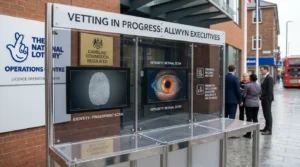
The Gambling Commission does considerably more than issue the operating licence.
Its legal duties include ensuring the National Lottery is run with due propriety, protecting participants and seeking to maximise returns to Good Causes after those first two obligations have been met.
Certain individuals involved in managing or benefiting from the National Lottery are subject to Fit and Proper requirements.
Current vetting can examine identity, integrity, criminal history and financial integrity. The Commission uses Verifile Limited for specified Fit and Proper checks, with additional national-security vetting available for certain Lottery Beneficiaries.
This means regulatory scrutiny extends beyond Allwyn as a corporate entity to key individuals occupying sensitive positions.
Who Owns The National Lottery Brand?
A less widely understood point is that the Gambling Commission owns the National Lottery trademarks, including its recognised brand assets.
Those trademarks are licensed to Allwyn for use while it operates the National Lottery. Under its licence, Allwyn is also required to take action where National Lottery branding is being used improperly.
This arrangement helps protect the National Lottery as a public asset rather than making the branding the permanent property of whichever commercial operator currently holds the licence.
How Is Allwyn Modernising The National Lottery?
Allwyn operates through approximately 43,500 retail locations, alongside the National Lottery website and mobile apps.
Technology investment is a major part of the Fourth Licence. Vodafone partnered with Allwyn to upgrade the communications infrastructure supporting the National Lottery, including a more mobile-first approach to connectivity for retailers.
By March 2026, Allwyn said it had invested around £450 million in transformation, with one million additional active digital users recorded during 2025.
The Gambling Commission has also approved further changes during 2026, including a UK Powerball licence and changes to existing game licences.
Who Leads Allwyn UK In 2026?
There has been an important recent leadership change.
Phil Walker became Interim Chief Executive Officer of Allwyn Entertainment Limited on 7 September 2026, succeeding Andria Vidler.
Allwyn said Vidler stepped down after major Fourth Licence transition milestones had been completed, including upgrades to retail infrastructure, the website and apps. Justin King remains a key figure as Allwyn UK chairman.
Older articles naming Andria Vidler as the current CEO should therefore be updated.
How Does Allwyn Approach Player Protection?
Player protection remains part of both Allwyn’s operating responsibilities and the Gambling Commission’s regulatory oversight.
Allwyn uses digital data and technology to identify potentially problematic behaviour, while the Fourth Licence gives the Gambling Commission powers to monitor whether sufficient protections are being maintained.
Players concerned about gambling behaviour can also review the signs of a gambling problem and information on helping someone with a gambling addiction.
The National Lottery should be treated as paid entertainment rather than a means of making regular income.
Conclusion
So, who runs the National Lottery? In 2026, the answer is Allwyn Entertainment Ltd.
Allwyn has operated the lottery since 1 February 2024 and holds the Fourth National Lottery Licence until 31 January 2034.
Its role goes far beyond running draws. The business manages a nationwide retail and digital operation, invests in technology, develops games and generates funding for Good Causes.
However, responsibility is deliberately divided. The Gambling Commission regulates the lottery and owns its major trademarks, while 12 independent distributors decide how Good Causes funding is allocated.
The Fourth Licence has also changed the commercial model by linking increases in operator profit more closely to increasing returns for Good Causes, making the performance of Allwyn and the National Lottery more directly connected over the remainder of the licence.
FAQs
Who Runs The National Lottery Now?
Allwyn Entertainment Ltd currently runs the UK National Lottery. It replaced Camelot on 1 February 2024.
How Long Will Allwyn Run The National Lottery?
The Fourth National Lottery Licence runs until 31 January 2034.
Does Camelot Still Run The National Lottery?
No. Camelot’s Third National Lottery Licence ended on 31 January 2024. Allwyn took operational control the following day.
Why Did Camelot Lose The National Lottery Licence?
The Gambling Commission selected Allwyn after a competitive Fourth Licence process. Camelot challenged the decision legally but later withdrew its appeal.
Who Decides Where National Lottery Money Goes?
Twelve independent National Lottery distributors allocate Good Causes funding across community, arts, heritage, film and sport projects. Allwyn does not decide which organisations receive grants.
Who Regulates Allwyn And The National Lottery?
The Gambling Commission licenses and regulates the National Lottery. It monitors propriety, participant protection and returns to Good Causes.
Can Another Company Run The National Lottery?
Only an organisation holding the relevant licence from the Gambling Commission can operate the National Lottery.
The current Allwyn licence expires in January 2034, after which future operating arrangements will depend on the applicable licensing process.
Disclaimer: This content is provided for informational purposes. Lottery participation involves spending money with no guaranteed return. Players must be aged 18 or over and should play responsibly.