
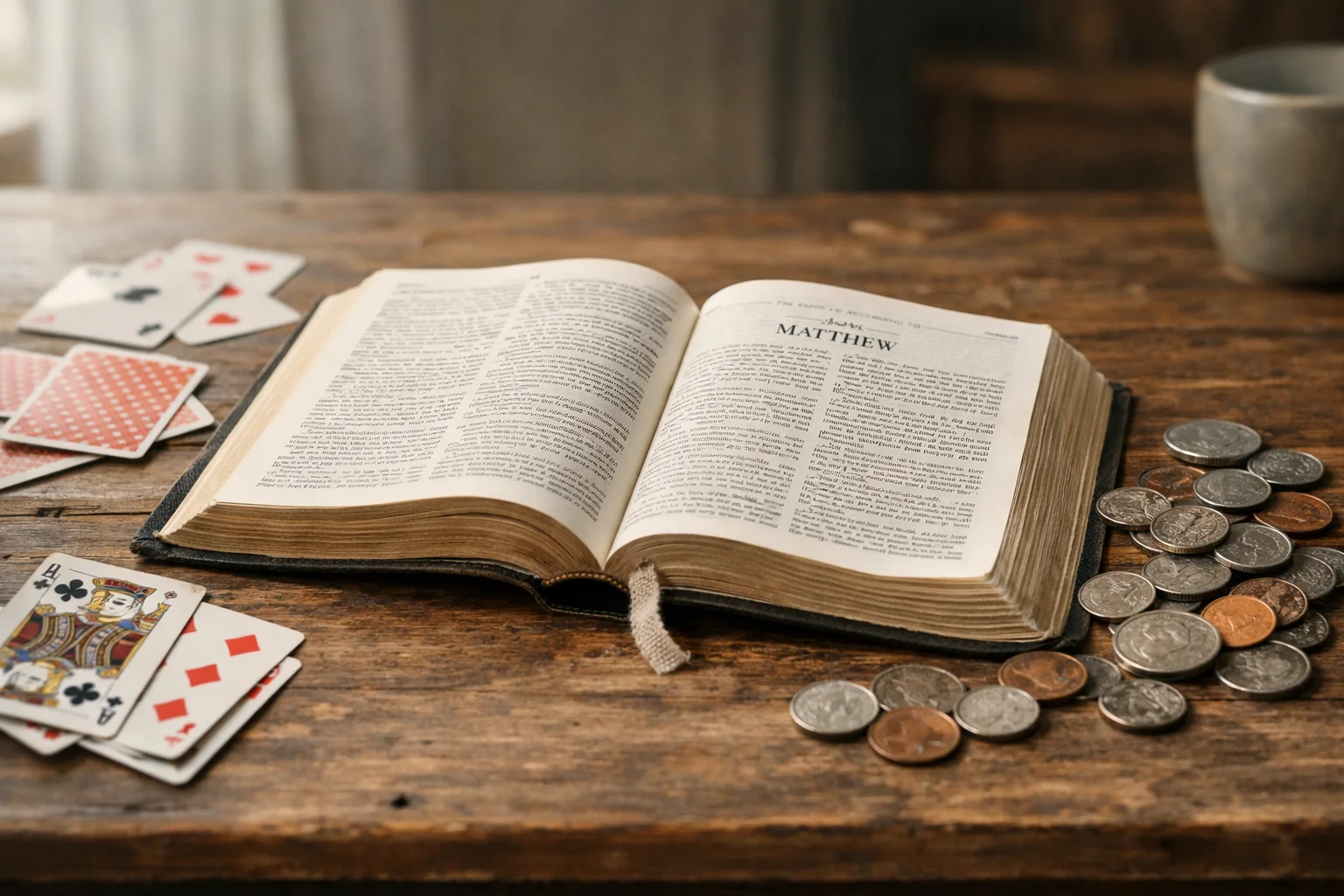
What Does the Bible Say About Gambling? | A Clear Biblical Perspective
The Bible does not mention gambling directly, the Bible provides strong guidance through its teachings on money, greed, and trust in God. Scripture warns against behaviours that are often linked to gambling, such as chasing quick wealth, poor stewardship, and reliance on chance over faith.
Key biblical principles related to gambling include:
- Gambling is not explicitly named but conflicts with biblical values
- The Bible warns against the love of money and quick riches
- Trust in God is encouraged over reliance on luck or chance
- Christians are called to be wise stewards of their finances
- Casting lots in Scripture is not equivalent to gambling today
- Gambling becomes sinful when it leads to greed, addiction, or neglect
Does the Bible Directly Mention Gambling?

The Bible does not directly mention gambling, betting shops or lottery tickets in any translation. This is primarily because gambling as we understand it today, including online casinos, sports betting and national lotteries, did not exist in ancient times.
However, the absence of the term does not mean the concept is not addressed. The underlying behaviours and heart conditions that lead people into gambling are frequently discussed in Scripture.
How Ancient Cultures Dealt with Chance?
In the ancient world, particularly within Israelite and early Christian cultures, people used practices such as “casting lots” to make decisions.
This method might be compared loosely to flipping a coin or drawing straws. However, the cultural and spiritual purpose was entirely different.
In several places in the Old Testament, casting lots was used to determine portions of land or appoint people to tasks.
For example:
- Joshua 18:10: “Joshua cast lots for them in Shiloh before the Lord”
- Leviticus 16:8: The high priest cast lots to determine the scapegoat
- Proverbs 16:33: “The lot is cast into the lap, but its every decision is from the Lord”
These examples show that the people used lots not for entertainment or personal profit, but as a way to seek divine will.
Gambling vs. Casting Lots – What’s the Difference?
To clarify the distinction, here’s a comparison in table format:
| Practice | Purpose | Involves Money | Motivated by Profit | Spiritually Directed |
| Casting Lots | Decision-making in a sacred context | No | No | Yes |
| Gambling | Personal gain and entertainment | Yes | Yes | No |
This makes it clear that biblical casting of lots is not the same as gambling and should not be used to justify modern betting practices.
What Does the Bible Say About the Love of Money?

One of the most frequently cited verses regarding wealth comes from 1 Timothy 6:10 which says, “For the love of money is a root of all kinds of evil.” This verse doesn’t condemn money itself but warns against making it an idol.
In the context of gambling, this is particularly relevant. Gambling thrives on the desire to win big without labour. It encourages risk without production, and the possibility of reward fuels the desire for more.
In my experience speaking with individuals who have struggled with gambling, the desire is rarely about enjoyment. More often, it’s about a longing for financial escape or validation through wealth.
I once interviewed a Christian financial advisor who had worked with gambling addicts. He told me, “I’ve rarely met someone who started gambling for the fun of it and didn’t later regret it.
The pattern is always the same: small wins lead to bigger bets, and before they know it, they’re in a cycle of loss and desperation.”
This aligns perfectly with the Bible’s view of money. When it becomes a source of identity or hope, it can easily corrupt.
Gambling often amplifies this problem by encouraging people to chase losses, risking more and more in pursuit of redemption that rarely comes.
How Does Gambling Conflict with Trusting God?
Scripture frequently highlights the importance of placing trust in God rather than material wealth or uncertain outcomes. Proverbs 11:28 warns us: “Whoever trusts in his riches will fall, but the righteous will flourish like a green leaf.”
In gambling, there is an underlying belief in odds, chance, or even luck. These ideas may seem harmless, but for a believer, they can slowly replace the foundational trust in God’s provision. The moment we place our hope in luck instead of the Lord, we are shifting spiritual allegiance.
Faith vs. Fortune – A Spiritual Conflict
This tension between faith and fortune is where gambling becomes more than just an activity. It becomes a reflection of our spiritual priorities.
Here’s a comparative table to illustrate this conflict:
| Foundation | Biblical Faith | Gambling Mindset |
| Source of Hope | God’s provision and promises | Chance, odds, luck |
| Means of Gain | Honest work and stewardship | Random outcomes and risk |
| Emotional Result | Peace, contentment, trust | Anxiety, obsession, dissatisfaction |
From my personal observations, the most concerning issue is how subtly gambling replaces God in a person’s life. A church member once confessed to me, “I stopped praying about my finances because I was convinced the next bet would fix everything.
I didn’t need God if the odds worked in my favour.” That statement cut deep because it captured the essence of why gambling is spiritually harmful. It undermines trust in God and invites dependence on chance.
What Does the Bible Teach About Financial Stewardship?

Financial stewardship is one of the core themes in Scripture. From Genesis to the teachings of Jesus, believers are encouraged to be faithful with what they have.
Stewardship goes beyond tithing; it’s about managing all resources wisely , time, talent, and treasure.
1 Corinthians 4:2 states, “Now it is required that those who have been given a trust must prove faithful.” Faithfulness here implies responsibility, care, and intentionality.
Gambling runs counter to this. It often involves:
- Risking resources with no guaranteed return
- Prioritising personal gain over ethical use of money
- Encouraging impulsivity rather than discipline
Here’s a table showing biblical stewardship compared to the gambling mindset:
| Stewardship Principle | Biblical View | Gambling Behaviour |
| Responsibility | Careful budgeting and spending | Wagering without planning |
| Purposeful Giving | Supporting family and community | Spending for personal thrill |
| Accountability | Answerable to God for resources | Detached from moral responsibility |
Why Responsible Money Habits Matter to Christians?
A responsible Christian sees money not only as a resource but as a tool for service. It enables us to provide for our families, give to those in need, support the Church, and build a future. When gambling consumes our income, we forfeit the opportunity to use those funds for God’s glory.
In many pastoral conversations, people who struggle with gambling regret not only the financial loss but the relational strain.
I recall a man telling me, “I could have paid my son’s tuition with what I lost last year. Instead, I was too embarrassed to tell my wife how much I had spent.” That moment underscored the reality that bad financial choices have relational consequences.
Why Does the Bible Warn Against Quick Wealth?

The Bible consistently warns against shortcuts to riches. Proverbs 13:11 clearly teaches, “Wealth gained hastily will dwindle, but whoever gathers little by little will increase it.” This verse points to a broader principle: fast money is unstable and often dangerous.
Gambling promises quick results. It preys on urgency and impatience, promising immediate returns in exchange for immediate risks. Unfortunately, most people do not win. Statistically, the odds are stacked against players, and long-term losses are almost guaranteed.
Below is a statistical table comparing gambling habits and outcomes in the UK:
| Gambling Activity | Average Return to Player (RTP) | Chance of Long-Term Loss | Associated Risks |
| Lottery Tickets | 45-55% | Very High | Addiction, False Hope |
| Slot Machines | 90-95% | High | Rapid Losses |
| Sports Betting | 85-90% | Moderate to High | Chasing Losses |
| Casino Table Games | 95-98% | High | Volatility, Risk Taking |
Gambling fits into the very definition of hasty wealth. It encourages the mindset of “winning big” without the investment of time, effort, or long-term discipline. This is not how the Bible encourages us to approach our finances.
Many Christians today are bombarded with adverts and apps promoting instant wins and easy cash. As a blogger focused on faith and finance, I can say confidently that any pursuit promising big returns with little effort should be viewed with suspicion.
Not because all risk is wrong, but because the Bible consistently teaches that wisdom, patience, and effort are what bring lasting gain.
Is Casting Lots the Same as Gambling in the Bible?
It is a common misunderstanding that casting lots in the Bible is similar to modern gambling. Let’s look deeper into the practice of casting lots in Scripture:
- Proverbs 16:33: “The lot is cast into the lap, but its every decision is from the Lord”
- Acts 1:26: The apostles cast lots to select Matthias
- Leviticus 16: The high priest cast lots to choose the scapegoat
These were sacred acts, conducted in prayerful submission to God. No profit was gained. No entertainment was involved.
Spiritual Discernment vs. Material Risk
To contrast the two, see this table:
| Criteria | Casting Lots (Biblical) | Gambling (Modern) |
| Purpose | Seeking God’s will | Personal gain |
| Setting | Religious or communal | Commercial or personal |
| Outcome | Accepted as divine direction | Left to probability |
| Financial Involvement | None | Often high stakes involved |
One pastor I spoke with summarised the difference by saying, “Casting lots was a spiritual act to determine God’s plan. Gambling is a secular act designed to enrich the individual. They couldn’t be more opposite.”
That distinction helps prevent misinterpretation of biblical practices in support of modern activities that conflict with faith-based values.
When Does Gambling Become a Sin According to the Bible?

Gambling in itself may not be categorically labelled as sin in Scripture, but it becomes sinful when it leads to behaviours that contradict biblical teachings.
This includes:
- Greed or covetousness
- Neglect of family or financial responsibilities
- Addiction or loss of self-control
- Loss of trust in God
Romans 14:23 provides a broader spiritual lens, stating, “Everything that does not come from faith is sin.” This principle encourages believers to assess their own convictions and the spiritual fruit of their actions.
If gambling leads you to hide behaviour, lie to loved ones, misuse resources, or lose peace of mind, it has crossed into sin.
In my experience counselling people through financial recovery, the key turning point always comes when they acknowledge that the issue is not just financial, it’s spiritual.
As one man told me, “I knew it was sin not because I lost money, but because I stopped caring who I was becoming.”
Conclusion
While the Bible doesn’t explicitly forbid gambling, it clearly warns against the dangers tied to it greed, poor stewardship, misplaced trust, and the pursuit of quick wealth.
As believers, we’re called to manage resources wisely, trust in God’s provision, and avoid behaviours that lead us away from faith.
Gambling often contradicts these principles. It’s not merely a financial decision but a spiritual one, and we must examine our hearts and habits through a biblical lens.
FAQs – What Believers Commonly Ask About Gambling
Is buying lottery tickets considered gambling in the Bible?
Yes, lottery participation falls under gambling. While the Bible doesn’t mention lotteries, the principles around money, greed, and trust still apply.
Can a Christian gamble occasionally without it being a sin?
Occasional gambling may not be sinful for everyone, but it’s important to check your heart, motives, and impact. If it leads to harm, it should be avoided.
What Bible verses can help someone struggling with gambling?
Helpful verses include 1 Timothy 6:10, Proverbs 13:11, and Matthew 6:24. These passages speak to money, contentment, and devotion.
Are there Christian organisations that help with gambling addiction?
Yes, groups like Gamblers Anonymous often partner with churches, and Christian counselling services provide support across the UK.
How do I explain to someone that gambling is spiritually harmful?
Start by pointing to the Bible’s warnings on greed and misplaced trust. Share examples of its emotional, financial, and spiritual toll.
What does the Bible say about money and wealth in general?
It teaches that wealth is not evil, but the love of it is. We are called to manage it wisely, give generously, and trust God, not riches.
Is it okay to play games involving money if it’s “just for fun”?
Even “fun” gambling can lead to harmful patterns. Evaluate your intentions and whether it could open the door to temptation or obsession.