
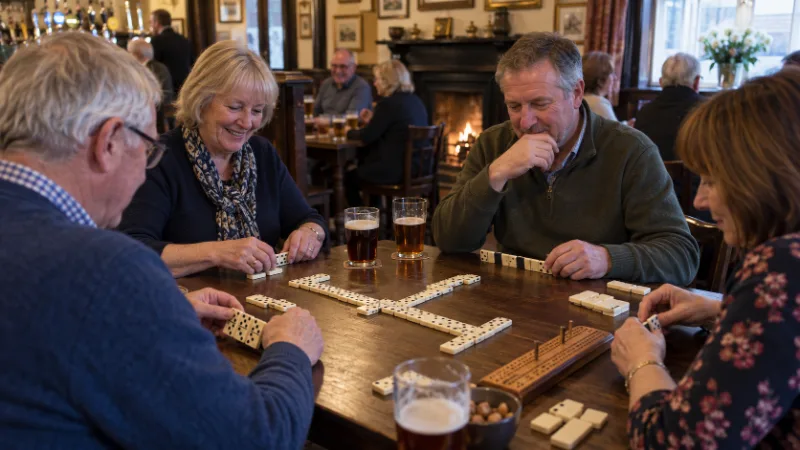
How To Play Dominoes: UK Rules, Scoring And Popular Variants
Everyone remembers the first time they sat around a table with friends or family, looking at a shuffled pile of rectangular tiles covered in dots. Across Britain and the Caribbean, dominoes is more than a matching game: it is part strategy, part competition and part social tradition.
My own curiosity grew during a lively gathering in Brixton, where the banter, concentration and sharp slap of tiles made it clear that dominoes could hold a room. That experience belongs to a much wider local culture.
The Brixton Immortals Domino Club has served the area’s African-Caribbean community since the 1970s and has competed in the Anglo Caribbean Dominoes League, connecting the game to generations of organised play in London.
For a beginner, the basic idea is simple: place a tile so that one of its ends matches an open end of the layout. Depending on the chosen variant, the aim is to play every tile first, finish with the lowest pip total, block the opposition or score particular combinations.
This guide explains the standard rules, two-player and partnership formats, British Fives and Threes, larger sets, spinners and the best-known regional variants.
What Is Dominoes?
Dominoes is a family of tile-based games. Each rectangular tile is divided by a central line, called the bar, into two square ends.
Each end displays a number of pips from zero upwards; a zero end is known as a blank. A tile with the same value on both ends, such as 6–6, is a double.
An individual domino may also be called a bone, a term linked to the material traditionally used to make some sets. Modern tiles are more commonly made from plastic, resin or wood.
Most familiar Western games fall into two broad groups:
- Blocking games, in which players try to empty their hand while restricting the moves available to opponents.
- Scoring games, in which certain layouts or open-end totals earn points during play.
The rules can be as straightforward as matching equal numbers, but strong play involves memory, counting, timing and judging which suits opponents may no longer hold.
Where Did Dominoes Originate?
The earliest written references to domino-like tiles come from Song-dynasty China in the 13th century. Traditional Chinese domino sets, however, differ from the later 28-tile Western set, and there is no proven direct line connecting the two traditions.
Modern European dominoes appeared in France during the mid-18th century and reached England by the late 1700s.
One long-repeated account says French prisoners of war helped introduce the game to Britain, although it is better treated as a historical theory rather than a settled fact.
The word domino may come from a black hooded carnival costume worn with a white mask.
One theory is that the contrasting black-and-white appearance, particularly that of the double-one tile, reminded players of the mask.
The precise etymology is not completely certain, but the costume explanation remains the best-known origin story.
What Equipment Do You Need to Play Dominoes?
All that is required is a domino set and a flat surface. A rack can keep a hand private, while a score sheet, counters or cribbage board helps with multi-round and scoring games.
How Many Tiles Are in Each Domino Set?
| Set | Highest double | Number of tiles | Common use |
| Double-six | 6–6 | 28 | Block, Draw, Fives and Threes and many partnership games |
| Double-nine | 9–9 | 55 | More players, Chicken Foot and Double-Nine Cross |
| Double-twelve | 12–12 | 91 | Mexican Train, larger groups and long branching games |
| Double-fifteen | 15–15 | 136 | Large groups and extended variants |
| Double-eighteen | 18–18 | 190 | Very large groups or specialist extended play |
The bigger the set, the more combinations it contains. Numerals or colour-coded pips are often used on extended sets because high pip totals can be difficult to read quickly.
What Are the Basic Rules of Dominoes?
The following rules describe a simple matching game using a double-six set:
- Place every tile face down and shuffle them thoroughly.
- Each player draws the agreed number of tiles and keeps the values hidden.
- The remaining tiles form the boneyard, also called the stock or sleeping tiles.
- The player holding the highest double normally starts. If nobody holds a double, either reshuffle or allow the highest-value tile to lead, depending on the agreed rule.
- Play moves around the table. Each new tile must match one of the open ends of the layout.
- A player who cannot move either draws or passes, depending on whether the group is playing Draw or Block dominoes.
- The round ends when somebody plays their last tile or the layout becomes blocked.
- The winner is determined by the chosen scoring rules.
One Turn at a Glance
| Situation | What the player does |
| A matching tile is available | Play one legal tile on an open end |
| No match in a Draw game | Draw according to the agreed rule, usually until a playable tile appears or the boneyard reaches its reserve |
| No match in a Block game | Knock or announce a pass; no tile is drawn |
| A double is played | Place it crosswise for clarity; it branches only if the variant treats it as a spinner |
| The player places their last tile | The player chips out and the round normally ends |
What Is the Difference Between Block and Draw Dominoes?
| Rule | Block dominoes | Draw dominoes |
| When a player cannot match | The player passes | The player takes one or more tiles from the boneyard under the agreed draw rule |
| Are sleeping tiles used during play? | No | Yes |
| Main strategic effect | Some unplayed tiles remain unknown | More of the set is gradually revealed |
| How the round ends | A player chips out or all players are blocked | A player chips out or nobody can move after the available draw tiles are exhausted |
| Typical scoring | Remaining pips in opponents’ hands | Remaining pips, sometimes including unplayed stock under local rules |
How Many Dominoes Does Each Player Draw?
There is no single deal for every version. The following table gives common English Block and Draw starting hands with a double-six set.
| Players | Block: tiles each | Block: sleeping tiles | Draw: tiles each | Draw: starting boneyard |
| 2 | 8 | 12 | 7 | 14 |
| 3 | 6 | 10 | 5 | 13 |
| 4 | 6 | 4 | 4 | 12 |
| 5 | 5 | 3 | 3 | 13 |
These are useful standard arrangements rather than universal laws. Some informal four-player Draw games deal five tiles each, leaving eight in the boneyard.
In Spanish, Latin American, Caribbean and Middle Eastern four-player formats, all 28 tiles are often dealt so that every player receives seven and there is no boneyard.
With four players, the most familiar team arrangement places partners opposite one another.
A player’s move should help the partnership, but secret signals and explicit coaching are normally prohibited unless a local social version allows them.
How Do Three-Player and Five-Player Games Work?
For a three-player Block game, deal six tiles each and leave ten sleeping. In Draw dominoes, deal five each and leave 13 in the boneyard. Players compete individually unless a special format says otherwise.
For five-player Block dominoes, deal five tiles each and leave three sleeping. In a five-player Draw game, deal three each and leave 13 to draw from.
A double-nine or double-twelve set can be a better choice if the group wants larger hands and a longer game.
How to Play Dominoes Step by Step?
Step 1: Choose the Rules
Decide whether the game is Block or Draw, how many tiles each player receives, what starts the round and how scoring will work. This takes less than a minute and prevents most disagreements.
Step 2: Shuffle and Draw
Turn all tiles face down and move them around with the flat of the hand. Each player draws a hand without showing the faces to anyone else.
Step 3: Play the Opening Tile
The highest double usually leads. If the highest double held is 5–5, that tile starts even if the 6–6 remains in the boneyard. Some formats rotate the lead after the first hand instead.
Step 4: Match an Open End
If the layout shows a three at one end and a six at the other, a legal tile must contain either a three or a six. Place matching ends together and leave the other end exposed for future play.
Step 5: Draw or Pass
In Draw dominoes, take from the boneyard when no legal play is available. Some rules require drawing until a match appears; others permit only one draw. In Block dominoes, simply knock or pass.
Step 6: End and Score the Round
A player chips out by placing their final tile. If nobody can make a legal move, the game is blocked. Players then count the pips left in their hands and apply the agreed scoring method.
How to Play Dominoes with Two Players?
A two-player Draw game is the easiest starting point for most beginners.
- Shuffle all 28 tiles face down.
- Each player draws seven tiles, leaving 14 in the boneyard.
- The holder of the highest double plays first.
- Players alternate, matching one of the two open ends.
- A player without a match draws under the agreed rule. If no usable draw remains, that player passes.
- The round ends when one player chips out or both players are blocked.
- The winner commonly scores the total pips left in the opponent’s hand.
For the English Block version, begin with eight tiles each and leave 12 sleeping. Players pass rather than draw when they cannot move.
How to Play Dominoes with Four Players?
Four-player dominoes may be played individually, but partnerships create a more tactical social game. Partners sit opposite one another so turns alternate between the two teams.
Step 1: Select the Four-Player Format
Choose one of these arrangements:
- English Block: six tiles each, with four sleeping tiles.
- Draw: four tiles each, with 12 in the boneyard.
- Full-deal partnership: seven tiles each and no boneyard.
- Informal beginner Draw: five tiles each and eight in the boneyard.
Step 2: Choose the Lead
The highest double normally starts the first hand. Later hands may be started by the previous winner or by rotating the lead clockwise.
Step 3: Play in Order
Play usually moves clockwise, although some regional games move counter-clockwise. Each player places one legal matching tile or follows the agreed pass/draw rule.
Step 4: Play for the Partnership
Partners combine their result at the end of the hand. A player can support a partner by keeping a useful number open, changing a dangerous end or forcing opponents towards suits they appear not to hold.
Step 5: Finish the Hand
The hand ends when one player chips out or nobody can move. In partnership scoring, the winning team normally receives the pip total held by the losing team. In a blocked hand, the team with the lower combined total generally wins, with the scoring difference or the opponents’ total used according to local rules.
Regional Full-Deal Formats
In a common Middle Eastern format, four players receive seven tiles each, the 6–6 starts and play may move counter-clockwise.
There is no boneyard, so a player without a match passes and may be described as a sitting or downed player.
A less common local rule requires the player on the sitting player’s left to pass them a tile; if it can be played, it must be used.
Spanish and Latin American partnership dominoes also commonly deal seven tiles to each of four players, with partners sitting opposite.
If somebody chips out, their team scores the pips left in the opposing team’s hands. If the game blocks, the team holding the lower combined pip total wins under the agreed scoring rules.
What Is a Spinner in Dominoes?
A spinner is a double that can accept matching tiles on all four sides. It turns a simple two-ended line into a branching layout with three or four active arms.
Not every crosswise double is automatically a spinner. In ordinary Block or Draw play, placing a double across the line is often only a visual convention and play continues from its outer end.
The rule set must specifically allow branching.
Spinner rules vary:
- Only the opening double may branch, as in Cross Dominoes.
- The first double played may become the only spinner.
- Every double may branch, producing a tree-shaped layout.
- A spinner may have to be completed on specified sides before play can continue elsewhere.
Understanding this distinction makes Mexican Train, Chicken Foot, All Fives variations and Cross Dominoes much easier to learn.
What Are the Different Types of Domino Games?
| Variant | Set or format | What makes it different? |
| Block | Usually double-six | Players pass rather than draw when no match is available |
| Draw | Usually double-six | A player without a match draws from the boneyard |
| Fives and Threes | Double-six, often four-player pairs | Open-end totals divisible by three or five score on a cribbage board |
| All Fives or Muggins | Usually double-six | Multiples of five score during play; a missed declaration may be claimed under the Muggins rule |
| Mexican Train | Commonly double-twelve | Players build personal trains from a central engine and can use a shared public train |
| Chicken Foot | Commonly double-nine | A played double creates three matching branches that must be completed before normal play resumes |
| Texas 42 | Double-six, four-player pairs | A trick-taking game with bidding, trumps and 42 available points in each hand |
| Bergen | Usually double-six | Matching open ends score two points, or three when one of those ends is a double |
| Matador | Double-six | Touching ends normally add up to seven rather than match; special matador tiles can be played more freely |
| Cross Dominoes | Double-six | Four arms are built around the opening double before play continues |
| Double-Nine Cross | Double-nine | The opening cross branches and later doubles can create additional arms |
| Caribbean partnership dominoes | Usually double-six, four players | Full-deal team play places partners opposite and rewards memory, control and coordinated strategy |
Rules under the same name can differ between clubs, families and commercial sets, so the instructions supplied with a set or the host’s declared house rules should settle any variation.
How Do You Play Fives and Threes?
Fives and Threes is one of the most important domino games for a UK audience because it is widely associated with British pubs, social clubs and league play.
It is commonly played by four people in two partnerships, with a double-six set and a cribbage board.
Tiles are joined by matching equal ends, as in Block dominoes. After each play, add the pips on the exposed ends of the layout.
A total divisible by three earns one point for every three; a total divisible by five earns one point for every five. If the total is divisible by both, both scores are added.
Fives and Threes Scoring Examples
| Open-end total | Calculation | Points scored |
| 5 | One group of five | 1 |
| 6 | Two groups of three | 2 |
| 9 | Three groups of three | 3 |
| 10 | Two groups of five | 2 |
| 12 | Four groups of three | 4 |
| 15 | Five groups of three plus three groups of five | 8 |
| 20 | Four groups of five | 4 |
For example, if a move leaves open ends totalling 15, the player or team pegs eight points: five for the five groups of three and three for the three groups of five.
A hand normally ends when a player chips out or the layout becomes blocked. If neither side has reached the match target, the tiles are shuffled and another hand begins.
A target of exactly 61 is common in British club play, although matches to 31 or 121 and non-exact finishes are also used. Agree the target and whether an overscore is ignored before beginning.
League rules may also specify the number of tiles dealt, who leads the next hand, whether doubles count both halves when exposed and how a blocked hand is handled.
These details should follow the competition’s rule sheet.
How Does All Fives or Muggins Scoring Work?
In All Fives, a player scores whenever the total of the exposed ends is a multiple of five. Some tables record the actual total, while others peg one game point for each group of five. Confirm the system before play.
Worked Open-End Example
Suppose the open ends are three and six. A player attaches 6–6 to the six end and the rule set counts both halves of the exposed double.
The new total is:
3 + 6 + 6 = 15
Because 15 is divisible by five, it is a scoring play. Under raw-point rules it scores 15; under a five-count system it scores three game points.
In a larger branching layout, exposed arms showing 8, 5 and 12 produce 8 + 5 + 12 = 25, another multiple of five. Only genuinely open arms are counted.
Worked End-of-Hand Example
One common Muggins method subtracts the winner’s remaining pips from each opponent’s total and rounds each difference to the nearest five:
2
0
| Hand | Remaining pips | Calculation | Rounded score | |||||
| Winner | 3 | — | — | |||||
| Opponent 1 | 11 | 11 − 3 = 8 | 10 | |||||
| Opponent 2 | 6 | 6 − 3 = 3 | 5 | |||||
| Opponent 3 | 5 | 5 − 3 = |
The winner receives 15 additional points. This rounding method is not used in every Muggins game, so local rules take priority.
The name “Muggins” is also associated with a declaration rule: if a player fails to announce a valid multiple-of-five score, an opponent may call “Muggins” and claim the missed points.
Not every modern version uses this penalty.
What Happens When Nobody Can Make a Move?
A game is blocked when no player can legally match either open end and no permitted draw can change the position.
This is different from one person being unable to play; a single player who passes is not enough to end the hand.
Once the game is blocked, every player counts the pips left in their hand. In an individual game, the lowest total usually wins.
In partnerships, the pair with the lower combined total normally wins.
Depending on the agreed rules, the winners may score:
- The opponents’ remaining pip total;
- The difference between the two sides’ totals; or
- One game or end rather than a pip-based score.
If the totals are tied, some rules award the hand to the side that led, while others declare no score. Decide the tie rule in advance.
What Are the Best Dominoes Strategies for Beginners?
Play Heavy Tiles Before They Become a Liability
Tiles with many pips can be costly if the round blocks. Playing a 6–6 or 6–5 early may reduce the score left in the hand, although a valuable double should not be discarded without considering control of the suit.
Keep More Than One Number Available
A hand dominated by one suit can be powerful while that number remains open and awkward once opponents close it. Retaining tiles across several suits preserves options.
Track Passes and Draws
If an opponent passes when the open ends are two and five, they probably held neither number at that moment. That information can help a player reopen the same values later and force another pass.
Count the Suits
In a double-six set, each number appears on seven tiles when all tiles containing that number are counted. Watching those tiles enter the layout helps reveal whether an open end is safe or likely to be blocked.
Use Doubles at the Right Time
Doubles can preserve an exposed number, create a branch in spinner games or leave a high pip penalty in the hand. Their value depends on timing rather than size alone.
Think for the Partnership
In team play, do not judge a move only by the next opponent. Consider whether the tile leaves an end that a partner has previously played confidently or avoids a number on which the partner has passed.
Dominoes rewards the same broad habits of observation, probability and controlled risk found in other strategy-led table games. Readers who enjoy that style of thinking can also learn how to play poker.
What Makes Caribbean Dominoes Distinctive?
Caribbean dominoes is often played as a four-person partnership game with all seven tiles dealt to each player.
It is known for speed, confident tile placement and a lively social atmosphere, but beneath the noise lies serious memory and positional skill.
Players monitor which suits have been played, note every pass and try to control the ends for their partner. Rules and scoring vary by island, club and household.
Some games award points for opponents’ remaining pips, while others count games, bonus conditions or shut-outs.
In Brixton, organised dominoes has a visible community history. The Brixton Immortals and the Anglo Caribbean Dominoes League show how a game carried through Caribbean communities became part of London’s sporting and social life.
The atmosphere may be expressive, but formal partnership play generally forbids deliberate coded signals or revealing a hand.
Dominoes Glossary for Beginners
| Term | Meaning |
| Bone | Another name for an individual domino tile |
| Pip | A spot printed or inlaid on a tile |
| Blank | An end with zero pips |
| Bar | The dividing line between the two ends of a tile |
| Double | A tile with the same value on both ends, such as 4–4 |
| Boneyard | Face-down tiles that have not been dealt; also called the stock or sleeping tiles |
| Open end | An exposed end of the layout on which another tile may be played |
| Chip out | Play the final tile in a hand |
| Stitched up | Leave the same number showing at both open ends of the line |
| Knock | Signal that no legal tile can be played in a Block game |
| Blocked game | A position in which nobody can make a legal move |
| Spinner | A double that the rules allow players to build from on multiple sides |
| Suit | All tile ends showing the same number, such as the sixes |
| Hand | The tiles held by one player |
Conclusion
Learning how to play dominoes begins with one rule: match an open end, but the game quickly develops into something richer.
Block and Draw teach the core mechanics, partnership play adds cooperation, Muggins rewards arithmetic, and Fives and Threes brings the tradition of British pub and league dominoes to the table.
Beginners should start with a double-six set, agree the rules before dealing and play several short hands before introducing spinners or extended sets.
Once passing patterns, pip totals and suit control become familiar, variants such as Mexican Train, Chicken Foot, Texas 42 and Matador offer genuinely different challenges.
Those interested in another highly social game with distinctive terminology and turn structure can also explore craps rules for beginners.
FAQs
What does “blocked” mean in dominoes?
Blocked means that no player can legally match either open end and no permitted draw can produce further play. Players then count the pips remaining in their hands to determine the winner under the agreed rules.
What is the difference between Block and Draw dominoes?
In Block dominoes, a player who cannot make a legal move passes. In Draw dominoes, that player takes one or more tiles from the boneyard according to the chosen rules.
How many dominoes are in a double-twelve set?
A double-twelve set contains 91 unique tiles, ranging from 0–0 to 12–12.
Where did dominoes originate?
Domino-like tiles are recorded in Song-dynasty China, but modern Western dominoes appeared in France in the mid-18th century.
The game reached England by the late 1700s, possibly through French prisoners of war, although no direct connection between Chinese and European dominoes has been proven.
What is Fives and Threes?
Fives and Threes is a British scoring game in which players match tiles and score when the exposed-end total is divisible by three or five.
It is often played by two partnerships and scored to an agreed target on a cribbage board.
How many dominoes are in a double-six set?
A standard double-six set contains 28 unique tiles.
How many dominoes do two players draw?
In a common two-player Draw game, each player takes seven tiles. In one traditional English Block arrangement, each takes eight. The correct number depends on the chosen variant.
Can dominoes be played with more than four people?
Yes. Five people can use a double-six set with smaller hands, while double-nine, double-twelve, double-fifteen and double-eighteen sets provide more tiles for larger groups.
What happens if nobody has a double to start?
Many groups reshuffle and deal again. Others let the holder of the highest-value non-double tile start. Agree the rule before the game.
Is every double a spinner?
No. A double is a spinner only when the chosen variant allows tiles to branch from its sides. In an ordinary straight-line game, a crosswise double may remain part of a two-ended chain.