Rules Of Blackjack Card Game: Complete Playing Guide
The rules of blackjack card game are straightforward at their core. Players try to beat the dealer by finishing with a hand closer to 21 without exceeding 21.
However, decisions such as hitting, standing, doubling, splitting and surrendering can make the game considerably more strategic than it first appears.
Blackjack tables can also use different rules for dealer play, payouts, decks, splitting and side bets. Understanding those differences is important because seemingly small rule changes can affect how the game should be played.
What Is Blackjack?
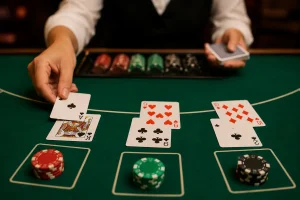
Blackjack is a comparing card game in which each player competes against the dealer rather than against other players at the table.
The objective is not necessarily to reach exactly 21. A player wins by having a valid hand worth more than the dealer’s hand, or when the dealer exceeds 21 while the player’s hand remains at 21 or below.
A standard game can use one or several 52-card decks.
Blackjack Card Values
| Card | Value |
| 2–10 | Face value |
| Jack | 10 |
| Queen | 10 |
| King | 10 |
| Ace | 1 or 11 |
An Ace automatically takes whichever value gives the hand the strongest valid total.
For example, Ace-6 is normally a soft 17 because the Ace counts as 11. If another 8 is dealt, the Ace changes to 1, creating a total of 15 rather than 25.
How A Blackjack Table Is Set Up?
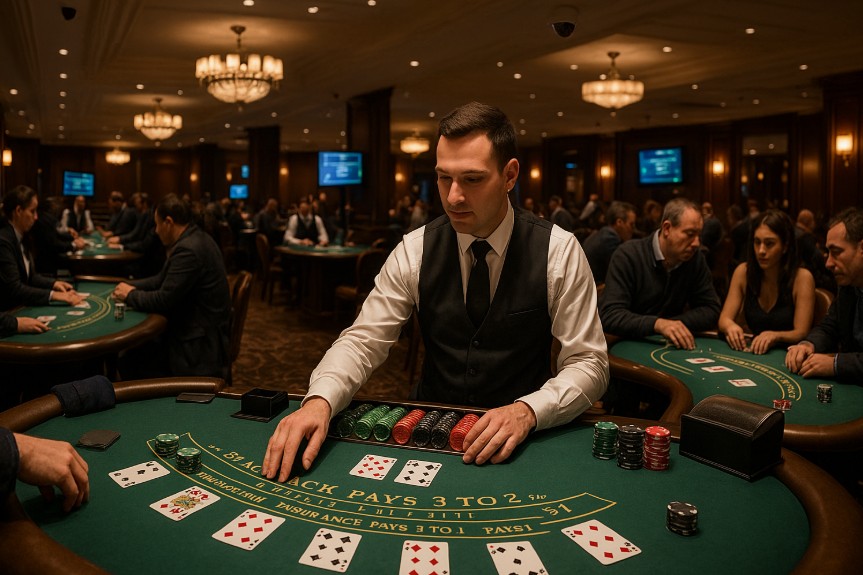
Traditional blackjack tables are usually curved or semicircular, with several player betting positions facing the dealer. The exact number of positions varies by casino and game format.
The dealer normally has access to the card shoe, discard tray and chip tray. Each betting position contains an area where the player’s wager is placed.
The player does not need to touch the cards in many modern shoe-dealt games. In land-based casinos, players may instead use recognised hand signals to communicate decisions.
How To Play Blackjack Step By Step?
1. Place The Bet
Players put their wager in the betting area before cards are dealt.
Minimum and maximum bets vary by table.
2. Receive The Initial Cards
Each player normally receives two cards.
The dealer also receives cards, although dealing procedures differ. Some games give the dealer a face-down hole card immediately, while European-style games may not deal the second dealer card until players have completed their decisions.
3. Check For Blackjack
A natural blackjack consists of:
- One Ace
- One 10, Jack, Queen or King
A natural blackjack traditionally pays 3:2, although some games pay 6:5.
A 6:5 payout is less favourable to the player, so the advertised blackjack payout should always be checked before playing.
4. Make A Playing Decision
The player then chooses from the available actions.
5. Hit
Take another card.
The player can continue hitting until they stand or exceed 21.
6. Stand
Keep the current total and take no more cards.
At a physical table, this is commonly indicated by moving a hand horizontally above the cards.
7 Double Down
Increase the original wager, usually by an amount up to the original bet, and receive exactly one additional card.
Some casinos allow doubling for less, where the additional wager is smaller than the original stake.
Although permitted at some tables, reducing the double generally gives up value compared with making the full mathematically correct double.
8. Split
When the first two cards are an eligible pair, they may be divided into two separate hands.
An additional wager equal to the original wager is normally required.
Rules can differ on:
- Re-splitting pairs
- Re-splitting Aces
- Hitting split Aces
- Doubling after splitting
9. Surrender
Some blackjack games allow a player to surrender their initial hand and lose only half the original wager.
Surrender is not available at every table.
What Happens When The Dealer Plays?
After all active players have completed their hands, the dealer finishes their own hand according to fixed rules.
The dealer does not choose strategically like a player.
A common rule is:
- Dealer hits on 16 or lower
- Dealer stands on 17 or higher
The important exception is soft 17.
Some tables require the dealer to stand on soft 17, while others require the dealer to hit. A dealer-hits-soft-17 rule is generally less favourable to players.
How Blackjack Hands Are Settled?
Once the dealer finishes:
- Player busts = Player loses
- Dealer busts while player remains active = Player wins
- Player total higher than dealer = Player wins
- Dealer total higher than player = Dealer wins
- Equal totals = Push
- Player blackjack normally beats an ordinary dealer 21
- Player and dealer blackjack normally result in a push
A push returns the original main wager without a profit or loss.
Insurance And Even Money
Insurance is offered when the dealer’s visible card is an Ace.
The player normally wagers up to half the original bet on whether the dealer has blackjack. If the dealer does have blackjack, insurance commonly pays 2:1.
Insurance should be treated as a separate wager rather than protection for the original hand.
What Is Even Money?
Even money is commonly offered when the player already has blackjack and the dealer shows an Ace.
Accepting it guarantees a 1:1 return on the player’s blackjack rather than waiting to discover whether the dealer also has blackjack.
Mathematically, accepting even money is effectively the same economic decision as taking insurance on a blackjack hand.
Special Blackjack Situations
Dealer Shows A 10 And Has Blackjack
At games using a hole-card and peek procedure, a dealer showing a 10-value card may check immediately for blackjack.
If blackjack is confirmed, normal losing wagers can be collected without offering insurance because insurance is normally associated with a dealer Ace.
European no-hole-card procedures work differently, so players should check the table rules.
Dead Hand
If every player busts before the dealer needs to complete their hand, the dealer may simply collect the losing wagers without drawing further cards.
There is no reason to complete the dealer hand when no active player remains.
Basic Blackjack Strategy

Basic strategy uses probability to determine the statistically preferable action based on the player’s cards and the dealer’s visible card.
A simplified guide looks like this:
| Player Hand | General Decision |
| Hard 8 or below | Hit |
| Hard 9 | Double against some weak dealer cards, otherwise hit |
| Hard 10 | Often double against 2–9 |
| Hard 11 | Frequently double where rules permit |
| Hard 12 | Usually stand against 4–6, hit otherwise |
| Hard 13–16 | Usually stand against 2–6, hit against stronger cards |
| Hard 17+ | Stand |
| Aces | Normally split |
| 8s | Normally split |
| 10s | Normally stand |
| 5s | Usually play as a hard 10 rather than splitting |
This is only a simplified reference. The correct move changes according to deck count, dealer soft-17 rules, surrender availability and whether doubling after splitting is permitted.
A more complete basic blackjack strategy covers the individual hit, stand, double and split decisions in greater depth.
Composition-Dependent Strategy
Basic strategy normally focuses on the total value of the hand.
Composition-dependent strategy goes further by considering exactly which cards created that total.
For example, two different combinations producing 16 may occasionally have slightly different mathematical properties because different cards have already been removed from the deck.
These differences are usually more relevant to advanced players than beginners.
Blackjack Variants Around The World
Blackjack does not have one universal ruleset.
European Blackjack
European versions commonly use multiple decks and may operate without giving the dealer a hole card until players have finished their hands.
Atlantic City Blackjack
Atlantic City rules traditionally include features such as late surrender and dealer standing on soft 17, although individual tables can vary.
Pontoon
Pontoon is related to blackjack but uses different terminology and rule combinations. Rules can also differ significantly between British casino Pontoon and other international games using the same name.
Perfect Pairs And 21+3
These are generally side bets, rather than replacements for the main blackjack game.
Perfect Pairs pays according to whether the player’s first two cards form particular types of pair.
21+3 combines the player’s first two cards with the dealer’s upcard to create poker-style three-card combinations.
Side bets have their own payouts and house edges separate from the main blackjack wager.
Blackjack Variants To Check Carefully
Some games resemble standard blackjack but make significant rule changes. They are not necessarily illegitimate games, but players should not assume ordinary blackjack strategy or odds still apply.
Super Fun 21
Super Fun 21 provides unusually flexible rules for doubling, splitting and surrendering.
The trade-off is important. Most natural blackjacks commonly pay only even money rather than the traditional 3:2.
Spanish 21
Spanish 21 normally removes the four 10 cards from each deck while retaining Jacks, Queens and Kings.
It compensates with favourable player rules and bonuses.
Spanish 21 should not automatically be described as worse than blackjack. Depending on the exact table rules, its mathematical house advantage can be competitive with conventional blackjack.
Free Bet Blackjack
Free Bet Blackjack can provide free doubles and free splits in qualifying situations.
The major trade-off is the dealer-22 rule. When the dealer reaches exactly 22, many otherwise winning player hands push instead.
Blackjack Switch
Players begin with two hands and can exchange the second card between them.
That powerful option is balanced by rules that commonly include dealer 22 pushing against surviving hands and reduced blackjack payouts.
The main lesson is simple: read the rules rather than assuming every game containing the word blackjack behaves like standard blackjack.
Card Counting And Advantage Play
Basic strategy reduces avoidable playing errors, but it does not normally eliminate the casino’s mathematical advantage.
More advanced techniques include:
- Card counting
- Shuffle tracking
- Ace sequencing
- Composition-dependent play
- Hole-card observation
- Edge sorting
Card counting estimates the changing composition of the undealt cards rather than predicting individual cards.
The detailed card counting in blackjack explains running counts, true counts, deck penetration and UK considerations.
Some other advantage-play techniques depend on unusual dealing conditions or information that is not normally available. Players must follow casino rules and applicable gambling law.
Common Blackjack Mistakes
New players commonly lose additional value by making avoidable decisions such as:
- Taking insurance automatically
- Playing by instinct rather than basic strategy
- Splitting 10s in ordinary situations
- Refusing to split Aces or 8s
- Ignoring whether blackjack pays 3:2 or 6:5
- Assuming every blackjack variant uses standard rules
- Treating side bets as part of basic strategy
- Chasing losses by increasing wagers
No betting progression changes the underlying probability of the cards.
Playing Blackjack Online
The basic objective remains the same online, but players should inspect the game information before betting.
Check:
- Blackjack payout
- Number of decks
- Dealer soft-17 rule
- Double restrictions
- Split rules
- Surrender availability
- Dealer hole-card procedure
- Side-bet paytables
Live-dealer games reproduce much of the physical table experience, while computer-based blackjack uses software to deal and resolve hands.
Is Blackjack A Game Of Skill Or Luck?
Blackjack involves both.
Luck determines which cards appear during an individual hand. Skill affects how efficiently the player responds to those cards.
Basic strategy cannot guarantee a winning session. It simply identifies statistically stronger decisions over a large number of hands.
Even perfect play still involves variance and, under most normal rules, a long-term casino advantage.
Origins Of Blackjack
Modern blackjack developed from earlier European games based on reaching a total of 21, particularly the French game Vingt-Un, meaning twenty-one.
Rules changed as the game spread between countries and casinos. Different payout structures, dealer procedures and regional versions eventually developed into today’s blackjack formats.
The word blackjack later became associated with the modern casino game, although Britain also developed an unrelated shedding game known as Black Jack. That shared name explains why searches for blackjack rules can sometimes return instructions for two completely different card games.
Conclusion
The core rules of blackjack card game are simple: build a stronger hand than the dealer without exceeding 21.
The important details lie in the table rules. Blackjack payouts, soft-17 procedures, doubling, splitting, surrender, dealer hole cards and side bets can all change how a particular game works.
Players should also distinguish standard blackjack from Pontoon, Spanish 21, Free Bet Blackjack, Blackjack Switch, Super Fun 21 and the unrelated British 7 Card Black Jack game.
Learning the rules first and applying the correct basic strategy for the specific table provides a much stronger foundation than relying on betting systems or intuition.
Frequently Asked Questions
What Are The Basic Rules Of Blackjack?
Players attempt to beat the dealer without exceeding 21. They can normally hit, stand, double or split depending on their cards and the table rules.
Does The Dealer Have To Hit On 16?
Yes. Standard blackjack requires the dealer to hit totals of 16 or less. Rules differ on whether the dealer hits or stands on soft 17.
Does Blackjack Have To Be Exactly 21?
No. A player can win with any valid total higher than the dealer’s total. Reaching 21 is not necessary.
What Is A Natural Blackjack?
A natural blackjack is an Ace plus a 10-value card as the player’s first two cards.
Should You Always Take Insurance?
No. Insurance is a separate wager on the dealer having blackjack and generally carries a casino advantage unless unusual card-composition information changes the calculation.
Is 7 Card Blackjack The Same As Casino Blackjack?
No. British 7 Card Black Jack is usually a shedding game where players try to discard their cards. Casino blackjack involves competing against the dealer with totals based around 21.
Are Blackjack Side Bets Part Of The Main Game?
No. Bets such as Perfect Pairs and 21+3 are optional wagers with separate rules, payouts and probabilities.
Responsible Gambling: Gambling should be treated as paid entertainment rather than a way to make money. In Great Britain, gambling is restricted to adults aged 18 and over. Set spending and time limits and never chase losses.