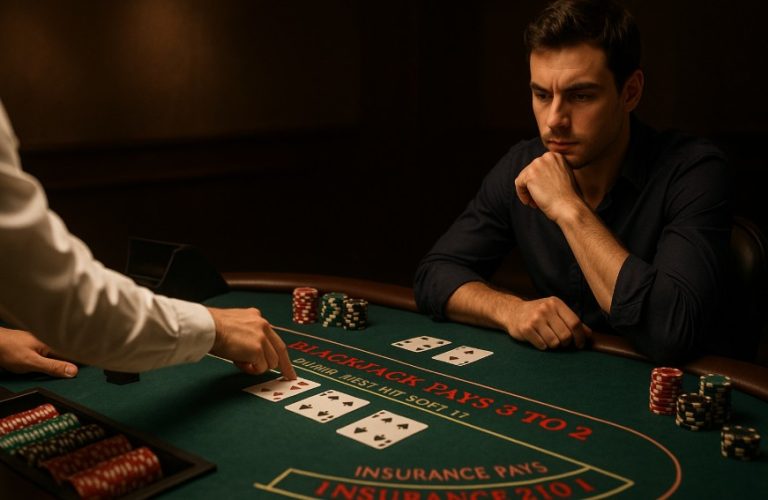

Basic Strategy Blackjack: UK S17, H17 and ENHC Charts
Last Updated On – 04-09-2026
Basic strategy blackjack is a mathematically calculated system for choosing whether to hit, stand, double, split or surrender. It cannot guarantee a winning session, but it identifies the decision with the best expected return for every player hand and dealer upcard.
For UK players, selecting the right chart is essential. Many British and European blackjack tables use European No Hole Card rules, commonly abbreviated to ENHC.
These rules can change important decisions, including whether to double 11 against a dealer 10 or split eights against a 10.
Players should therefore check the table rules before relying on any blackjack strategy chart.
What Is Basic Strategy in Blackjack?
Blackjack basic strategy is a set of mathematically optimal playing decisions based on two pieces of information:
- The player’s current hand
- The dealer’s visible upcard
It accounts for the probability of the dealer reaching different totals, the risk of the player going bust and the expected value of hitting, standing, doubling, splitting or surrendering.
Players unfamiliar with the game should first understand the standard rules of blackjack, including card values, natural blackjack payouts and dealer drawing requirements.
Basic strategy does not predict the next card. It simply selects the action expected to lose the least—or win the most—over a very large number of identical situations.
Which Blackjack Strategy Chart Should UK Players Use?
There is no single correct chart for every table. Players should inspect the game information screen or table rules before betting.
| Rule Observed | Appropriate Chart |
| Dealer stands on all soft 17s and checks for blackjack before players act | S17 hole-card chart |
| Dealer hits a soft 17 and checks for blackjack before players act | H17 hole-card chart |
| Dealer starts with one card and draws the second after players finish | ENHC chart |
| No hole card, but only the original stake is lost to dealer blackjack | S17 or H17 hole-card chart |
| Blackjack pays 6:5 rather than 3:2 | Avoid applying the house-edge figures below |
| The deck has cards removed or includes special rules | Use a chart created for that exact variant |
A table described as “European Blackjack” does not automatically use one standard set of rules. Deck count, doubling restrictions, surrender and the treatment of additional wagers can still differ.
How Does UK ENHC Strategy Differ From a US Blackjack Chart?
Under a typical US-style hole-card game, the dealer receives two cards at the beginning of the round. If the upcard is a 10 or Ace, the dealer normally checks the hidden card for blackjack before players split or double.
Under ENHC rules, the dealer initially receives only one card. Players complete their hands before the dealer draws a second card.
If that second card completes a blackjack, the player may lose the original stake and any additional money committed through splitting or doubling.
Consider a £10 wager with hard 11 against a dealer 10:
- Hole-card game: Once the dealer has checked and does not have blackjack, doubling is normally the correct move.
- ENHC game: Doubling would increase the stake to £20 before it is known whether the dealer has blackjack. The ENHC chart therefore says to hit.
The same logic affects pair splitting. With 8,8 against a dealer 10, a hole-card chart normally says to split. A conventional ENHC chart says to hit because splitting exposes a second stake to a possible dealer blackjack.
The critical ENHC changes include:
| Player Hand | Dealer Card | Hole-Card S17 | Hole-Card H17 | ENHC S17 |
| Hard 11 | 10 | Double | Double | Hit |
| Hard 11 | Ace | Hit | Double | Hit |
| 8,8 | 10 | Split | Split | Hit |
| 8,8 | Ace | Split | Surrender if available; otherwise split | Hit |
| A,A | Ace | Split | Split | Hit |
| A,7 | 2 | Stand | Double if permitted; otherwise stand | Stand |
| A,8 | 6 | Stand | Double if permitted; otherwise stand | Stand |
Some no-hole-card games use an Original Bets Only or OBO rule. If the dealer eventually has blackjack, additional split and double stakes are returned. In that situation, the important ENHC penalty disappears and the corresponding hole-card strategy can generally be used.
What Is the Correct Blackjack Decision Order?

Players should evaluate their options in the following sequence:
Surrender → Split → Double → Hit or Stand
- Check for surrender: It is normally available only on the first two cards.
- Check for a pair: If the hand qualifies for a recommended blackjack split, splitting is considered before the total is played normally.
- Check for a double: Follow the appropriate double-down strategy if doubling is permitted.
- Hit or stand: Use the final total-based decision when none of the earlier actions applies.
This order prevents a player from overlooking surrender or treating a pair as an ordinary hard total too early.
How Should the Blackjack Charts Be Read?
The player’s hand appears in the left column, while the dealer’s upcard appears across the top. The intersecting cell provides the correct action.
| Symbol | Meaning |
| H | Hit |
| S | Stand |
| D/H | Double if permitted; otherwise hit |
| D/S | Double if permitted; otherwise stand |
| P | Split |
| P* | Split if double after split is allowed; otherwise hit |
| R/H | Surrender if offered; otherwise hit |
| R/S | Surrender if offered; otherwise stand |
| R/P | Surrender if offered; otherwise split |
The following charts assume four to eight decks, blackjack paying 3:2, doubling on any initial two cards and double after split unless stated otherwise.
S17 Basic Strategy Chart
Use these tables when the dealer stands on soft 17 and checks for blackjack before additional player stakes are placed, or when an OBO rule protects additional stakes.
S17 Hard Totals
| Player Hand | 2 | 3 | 4 | 5 | 6 | 7 | 8 | 9 | 10 | A |
| 5–8 | H | H | H | H | H | H | H | H | H | H |
| 9 | H | D/H | D/H | D/H | D/H | H | H | H | H | H |
| 10 | D/H | D/H | D/H | D/H | D/H | D/H | D/H | D/H | H | H |
| 11 | D/H | D/H | D/H | D/H | D/H | D/H | D/H | D/H | D/H | H |
| 12 | H | H | S | S | S | H | H | H | H | H |
| 13–14 | S | S | S | S | S | H | H | H | H | H |
| 15 | S | S | S | S | S | H | H | H | R/H | H |
| 16 | S | S | S | S | S | H | H | R/H | R/H | R/H |
| 17–21 | S | S | S | S | S | S | S | S | S | S |
S17 Soft Totals
| Player Hand | 2 | 3 | 4 | 5 | 6 | 7 | 8 | 9 | 10 | A |
| A,2 | H | H | H | D/H | D/H | H | H | H | H | H |
| A,3 | H | H | H | D/H | D/H | H | H | H | H | H |
| A,4 | H | H | D/H | D/H | D/H | H | H | H | H | H |
| A,5 | H | H | D/H | D/H | D/H | H | H | H | H | H |
| A,6 | H | D/H | D/H | D/H | D/H | H | H | H | H | H |
| A,7 | S | D/S | D/S | D/S | D/S | S | S | H | H | H |
| A,8 | S | S | S | S | S | S | S | S | S | S |
| A,9 | S | S | S | S | S | S | S | S | S | S |
S17 Pair Splitting
| Pair | 2 | 3 | 4 | 5 | 6 | 7 | 8 | 9 | 10 | A |
| 2,2 | P* | P* | P | P | P | P | H | H | H | H |
| 3,3 | P* | P* | P | P | P | P | H | H | H | H |
| 4,4 | H | H | H | P* | P* | H | H | H | H | H |
| 5,5 | D/H | D/H | D/H | D/H | D/H | D/H | D/H | D/H | H | H |
| 6,6 | P* | P | P | P | P | H | H | H | H | H |
| 7,7 | P | P | P | P | P | P | H | H | H | H |
| 8,8 | P | P | P | P | P | P | P | P | P | P |
| 9,9 | P | P | P | P | P | S | P | P | S | S |
| 10,10 | S | S | S | S | S | S | S | S | S | S |
| A,A | P | P | P | P | P | P | P | P | P | P |
H17 Basic Strategy Chart
Use these tables when the dealer must hit a soft 17 and checks for blackjack before players split or double.
H17 Hard Totals
| Player Hand | 2 | 3 | 4 | 5 | 6 | 7 | 8 | 9 | 10 | A |
| 5–8 | H | H | H | H | H | H | H | H | H | H |
| 9 | H | D/H | D/H | D/H | D/H | H | H | H | H | H |
| 10 | D/H | D/H | D/H | D/H | D/H | D/H | D/H | D/H | H | H |
| 11 | D/H | D/H | D/H | D/H | D/H | D/H | D/H | D/H | D/H | D/H |
| 12 | H | H | S | S | S | H | H | H | H | H |
| 13–14 | S | S | S | S | S | H | H | H | H | H |
| 15 | S | S | S | S | S | H | H | H | R/H | R/H |
| 16 | S | S | S | S | S | H | H | R/H | R/H | R/H |
| 17 | S | S | S | S | S | S | S | S | S | R/S |
| 18–21 | S | S | S | S | S | S | S | S | S | S |
H17 Soft Totals
| Player Hand | 2 | 3 | 4 | 5 | 6 | 7 | 8 | 9 | 10 | A |
| A,2 | H | H | H | D/H | D/H | H | H | H | H | H |
| A,3 | H | H | H | D/H | D/H | H | H | H | H | H |
| A,4 | H | H | D/H | D/H | D/H | H | H | H | H | H |
| A,5 | H | H | D/H | D/H | D/H | H | H | H | H | H |
| A,6 | H | D/H | D/H | D/H | D/H | H | H | H | H | H |
| A,7 | D/S | D/S | D/S | D/S | D/S | S | S | H | H | H |
| A,8 | S | S | S | S | D/S | S | S | S | S | S |
| A,9 | S | S | S | S | S | S | S | S | S | S |
H17 Pair Splitting
| Pair | 2 | 3 | 4 | 5 | 6 | 7 | 8 | 9 | 10 | A |
| 2,2 | P* | P* | P | P | P | P | H | H | H | H |
| 3,3 | P* | P* | P | P | P | P | H | H | H | H |
| 4,4 | H | H | H | P* | P* | H | H | H | H | H |
| 5,5 | D/H | D/H | D/H | D/H | D/H | D/H | D/H | D/H | H | H |
| 6,6 | P* | P | P | P | P | H | H | H | H | H |
| 7,7 | P | P | P | P | P | P | H | H | H | H |
| 8,8 | P | P | P | P | P | P | P | P | P | R/P |
| 9,9 | P | P | P | P | P | S | P | P | S | S |
| 10,10 | S | S | S | S | S | S | S | S | S | S |
| A,A | P | P | P | P | P | P | P | P | P | P |
UK ENHC Basic Strategy Chart
This chart assumes four to eight decks, the dealer standing on soft 17, double after split, blackjack paying 3:2 and all additional split or double stakes being lost if the dealer subsequently draws blackjack.
ENHC Hard Totals
| Player Hand | 2 | 3 | 4 | 5 | 6 | 7 | 8 | 9 | 10 | A |
| 5–8 | H | H | H | H | H | H | H | H | H | H |
| 9 | H | D/H | D/H | D/H | D/H | H | H | H | H | H |
| 10 | D/H | D/H | D/H | D/H | D/H | D/H | D/H | D/H | H | H |
| 11 | D/H | D/H | D/H | D/H | D/H | D/H | D/H | D/H | H | H |
| 12 | H | H | S | S | S | H | H | H | H | H |
| 13–14 | S | S | S | S | S | H | H | H | H | H |
| 15–16 | S | S | S | S | S | H | H | H | H | H |
| 17–21 | S | S | S | S | S | S | S | S | S | S |
ENHC Soft Totals
| Player Hand | 2 | 3 | 4 | 5 | 6 | 7 | 8 | 9 | 10 | A |
| A,2 | H | H | H | D/H | D/H | H | H | H | H | H |
| A,3 | H | H | H | D/H | D/H | H | H | H | H | H |
| A,4 | H | H | D/H | D/H | D/H | H | H | H | H | H |
| A,5 | H | H | D/H | D/H | D/H | H | H | H | H | H |
| A,6 | H | D/H | D/H | D/H | D/H | H | H | H | H | H |
| A,7 | S | D/S | D/S | D/S | D/S | S | S | H | H | H |
| A,8 | S | S | S | S | S | S | S | S | S | S |
| A,9 | S | S | S | S | S | S | S | S | S | S |
ENHC Pair Splitting
| Pair | 2 | 3 | 4 | 5 | 6 | 7 | 8 | 9 | 10 | A |
| 2,2 | P* | P* | P | P | P | P | H | H | H | H |
| 3,3 | P* | P* | P | P | P | P | H | H | H | H |
| 4,4 | H | H | H | P* | P* | H | H | H | H | H |
| 5,5 | D/H | D/H | D/H | D/H | D/H | D/H | D/H | D/H | H | H |
| 6,6 | P* | P | P | P | P | H | H | H | H | H |
| 7,7 | P | P | P | P | P | P | H | H | H | H |
| 8,8 | P | P | P | P | P | P | P | P | H | H |
| 9,9 | P | P | P | P | P | S | P | P | S | S |
| 10,10 | S | S | S | S | S | S | S | S | S | S |
| A,A | P | P | P | P | P | P | P | P | P | H |
What If an ENHC Game Offers Early Surrender?
Early surrender allows a player to surrender before the dealer checks or draws for blackjack. It is unusual, but valuable when available.
Depending on the precise rules, an ENHC early-surrender chart may recommend surrendering:
- Hard 16 against 9, 10 or Ace
- Hard 15 or 14 against 10 or Ace
- Hard 13 or 12 against 10
- Hard 17 against Ace
- Hard 5, 6 or 7 against Ace
- A pair of eights against 10 or Ace
Players must confirm whether surrender is available against a dealer 10, Ace or both. If the game does not explicitly offer early surrender, these exceptions should be ignored.
What Should Players Do in Common Blackjack Hands?
The following examples demonstrate why the rule set must be identified before a decision is made.
| Player Hand | Dealer Card | Correct Play |
| 5,3 | 10 | Hit under all three charts |
| 5,4 | 5 | Double if allowed; otherwise hit |
| 6,4 | 9 | Double if allowed; otherwise hit |
| 7,4 | 10 | Double in hole-card games; hit under ENHC |
| 6,5 | Ace | Hit under S17 and ENHC; double under H17 |
| 10,2 | 3 | Hit |
| 10,2 | 4 | Stand in a multi-deck game |
| 7,6 | 6 | Stand |
| 9,6 | 10 | Surrender where permitted; otherwise hit |
| 10,6 | 10 | Surrender where permitted; otherwise hit |
| 10,7 | Ace | Stand under S17 and ENHC; surrender under H17 if offered |
| A,2 | 5 | Double if allowed; otherwise hit |
| A,6 | 2 | Hit |
| A,7 | 2 | Stand under S17 and ENHC; double under H17 |
| A,7 | 7 | Stand |
| A,7 | 9 | Hit |
| A,8 | 6 | Stand under S17 and ENHC; double under H17 |
| 8,8 | 10 | Split in a protected hole-card game; hit under ENHC |
| A,A | Ace | Split in a protected hole-card game; hit under ENHC |
| 9,9 | 7 | Stand rather than split |
These examples also show why statements such as “always double 11” or “always split Aces and eights” are not reliable without a rule-specific qualification.
How Does Deck Count Affect the House Edge?
All other rules being equal, fewer decks normally benefit the player. The following figures assume H17, double after split, no surrender, blackjack paying 3:2 and only the original stake being lost to dealer blackjack.
| Number of Decks | Approximate House Edge | Expected Long-Run Loss per £1,000 Staked |
| One | 0.16% | £1.60 |
| Two | 0.46% | £4.60 |
| Four | 0.60% | £6.00 |
| Six | 0.64% | £6.40 |
| Eight | 0.66% | £6.60 |
These are mathematical long-run averages, not predictions for a particular session. A player can win or lose far more than the theoretical figure over a short period.
Casinos may also offset a low deck count with less favourable rules. A single-deck game paying 6:5, for example, may be worse than a six-deck game paying 3:2.
Which Blackjack Rules Affect the House Edge Most?
| Rule Change | Approximate Effect |
| Blackjack pays 6:5 instead of 3:2 | Adds about 1.4 percentage points |
| Dealer hits rather than stands on soft 17 | Adds about 0.2 percentage points |
| Double after split not allowed | Adds about 0.12 percentage points |
| Full ENHC exposure instead of OBO protection | Adds about 0.11 percentage points |
| Doubling restricted to 10 and 11 | Adds approximately 0.2 percentage points |
| Late surrender available | Reduces the house edge by approximately 0.08 percentage points |
For comparison, a six-deck S17 game with favourable standard rules may have an edge near 0.44%. A comparable H17 game is closer to 0.64%, while a six-deck S17 ENHC game can be around 0.55% when doubling on any two cards is allowed.
How Much Can Blackjack Strategy Mistakes Cost?
The cost of a mistake is the difference between the expected value of the correct and incorrect action. Some emotionally difficult decisions are mathematically close, while apparently harmless errors can be expensive.
The following examples use an infinite-deck S17 game with double after split. The figures show expected value sacrificed per £1,000 of original stakes placed repeatedly on that exact decision—not a guaranteed cash loss during one session.
| Situation | Incorrect Decision | Correct Decision | Approximate EV Sacrificed per £1,000 |
| A,A against 6 | Hit | Split | £481.43 |
| Hard 18 against 9 | Hit | Stand | £433.37 |
| Hard 11 against 6 | Hit | Double | £333.69 |
| 10,10 against 6 | Split | Stand | £235.84 |
| Hard 15 against 6 | Hit | Stand | £212.13 |
| A,7 against 9 | Stand | Hit | £82.42 |
| 8,8 against 10 | Hit | Split | £59.14 |
| Hard 12 against 3 | Stand | Hit | £18.56 |
| Hard 16 against 10 | Stand | Hit | £0.60 |
The last example is important. Hard 16 against a dealer 10 attracts considerable debate, but hitting and standing are both poor outcomes and their expected values are extremely close.
The chart still identifies the better long-run play, but the most memorable decision is not necessarily the most expensive error.
These figures do not apply directly to ENHC hands where additional stakes are exposed to dealer blackjack.
Does Basic Strategy Work at UK Online and Live Casinos?
Yes. Basic strategy works for RNG blackjack, live dealer games and land-based tables because it is based on the rules and available cards—not the physical location of the dealer.
However, the correct chart still depends on the exact game.
| Blackjack Format | What Players Should Check |
| UK land-based shoe game | Deck count, ENHC treatment, S17/H17 and doubling restrictions |
| Live dealer blackjack | Number of decks, hole-card timing, OBO protection and split rules |
| RNG blackjack | Rules screen, payout, simulated deck count and reshuffling |
| Special blackjack variant | Removed cards, bonus rules, unusual doubles and altered payouts |
A casino brand may host several games supplied by different studios. Players should therefore check the individual table’s information panel rather than assuming that every blackjack game in the same lobby follows identical rules.
Special variants can remove particular cards, offer bonus payouts or change doubling rules. A normal S17, H17 or ENHC chart should not be used when the underlying deck or payouts have been modified.
Can Players Practise UK ENHC Basic Strategy?
The following quick exercise uses the main ENHC chart above: four to eight decks, S17, double after split and no surrender.
- Hard 10 against dealer 10
- Hard 12 against dealer 2
- A,5 against dealer 4
- A,7 against dealer 7
- 6,6 against dealer 2 with DAS
- 7,7 against dealer 8
- 9,9 against dealer 9
- 8,8 against dealer 10
- A,A against dealer Ace
- Hard 11 against dealer Ace
<details> <summary><strong>Reveal The Answers</strong></summary>
- Hit
- Hit
- Double if allowed; otherwise hit
- Stand
- Split
- Hit
- Split
- Hit
- Hit
- Hit
</details>
Players can make practice more effective by separating hands into three groups:
- Hard Totals: Learn the 12–16 boundary decisions first.
- Soft Totals: Concentrate on A,6, A,7 and A,8.
- Pairs: Memorise eights, Aces, nines, fours and DAS-dependent splits.
Demo play or flashcards can help develop speed without putting money at risk.
Why Is Blackjack Basic Strategy Mathematically Credible?

Basic strategy is not a betting myth developed from winning streaks. Its foundations were published in 1956 by Roger Baldwin, Wilbert Cantey, Herbert Maisel and James McDermott in The Journal of the American Statistical Association.
The four researchers used probability calculations and desk calculators to analyse the player’s available decisions. Their work became the foundation for modern blackjack strategy.
Edward O. Thorp subsequently used computer analysis to develop the subject further.
His 1962 book Beat the Dealer helped popularise card counting and demonstrated the important distinction between playing each hand efficiently and changing bets when the remaining deck becomes favourable.
Modern charts have been refined for deck count, dealer rules, surrender, splitting and no-hole-card conditions, but they follow the same expected-value principle.
When Is Standard Basic Strategy Not Quite Optimal?
Standard charts are usually total-dependent. They consider a hand’s total but not necessarily the exact cards producing it.
Composition-dependent strategy considers the individual cards. In a single-deck game, for example, the normal total-based decision is to stand on 12 against a dealer 4.
If the 12 consists specifically of 10 and 2, removing a 10 from the remaining deck can make hitting marginally better.
The improvement is small:
- Composition-dependent play can reduce the house edge by about 0.04 percentage points in a single-deck game.
- The improvement falls to approximately 0.003 percentage points with six decks.
For most UK multi-deck players, learning the correct ENHC or soft-17 chart is far more valuable than memorising composition-dependent exceptions.
Does Basic Strategy Apply to Blackjack Side Bets?
No. Perfect Pairs, 21+3, Lucky Ladies, Bust It and similar options are separate wagers with their own paytables and probabilities.
A correct hit, stand, double or split decision cannot reduce the house edge of a side bet. Depending on the version and paytable, common side bets can carry house edges ranging from roughly 3% to more than 20%.
Examples include:
| Side Bet | What Determines the Result | Why Basic Strategy Does Not Help |
| Perfect Pairs | Whether the first two player cards form a qualifying pair | Settled independently of the main-hand decision |
| 21+3 | Player’s first two cards plus the dealer upcard | Based on poker-style combinations |
| Lucky Ladies | Whether the player’s first two cards total 20 | Decided before hitting or standing |
| Bust It | Number or combination of cards causing a dealer bust | Player decisions do not alter its paytable |
The same caution applies to blackjack insurance. Under ordinary basic strategy, insurance and even money should not be taken. They become mathematically relevant only in specialised card-counting situations.
Is Basic Strategy the Same as Card Counting?
No. The two methods answer different questions.
| Basic Strategy | Card Counting |
| Determines how a hand should be played | Estimates whether the remaining shoe is favourable |
| Uses the player’s hand and dealer upcard | Tracks the balance of high and low cards |
| Works in RNG, live and land-based blackjack | Requires cards to remain out of play between rounds |
| Reduces the normal house advantage | May identify limited situations with a player advantage |
| Does not change according to previous hands | Changes as cards leave the shoe |
Basic strategy should be learned first. Players interested in the advanced mathematics can examine how counting cards in blackjack works, while the practical limitations are covered in the analysis of card counting in online blackjack.
Counting is generally ineffective in RNG games that reshuffle after each round. Live dealer games may use frequent shuffling or shallow deck penetration, which can also reduce its usefulness.
What Are the Most Common Basic Strategy Mistakes?
Frequent errors include:
- Using A US Chart At An ENHC Table: This can expose extra double or split stakes to dealer blackjack.
- Ignoring The Blackjack Payout: A 6:5 payout can damage the player more than small strategy improvements can recover.
- Taking Insurance: Insurance is not recommended by ordinary basic strategy.
- Splitting Tens: A total of 20 is normally too strong to break apart.
- Treating Soft Hands As Hard Totals: An Ace can often be counted as one after another card is drawn.
- Standing On Weak Totals Through Fear Of Busting: Avoiding a bust does not necessarily produce the best expected result.
- Following Other Players’ Opinions: Another player’s decisions do not change the mathematically correct action for the current hand.
- Using A Standard Chart For A Special Variant: Removed cards and bonus rules can require a completely different strategy.
Conclusion
Basic strategy is the most reliable way to remove guesswork from blackjack, but UK players should not treat it as one universal chart. The dealer’s hole-card procedure, soft-17 rule, blackjack payout, deck count, surrender rules and treatment of additional stakes all matter.
The biggest UK-specific distinction is ENHC. Under full no-hole-card exposure, players should hit rather than double hard 11 against a dealer 10, hit rather than split eights against a 10 and hit Aces rather than split them against a dealer Ace.
Using the correct chart can reduce expected losses, but it cannot guarantee a win or remove short-term volatility. Gambling should remain entertainment, with firm spending and time limits. Anyone finding it difficult to stop can consider self-exclusion from online gambling.
FAQs
Is Basic Strategy the Same at Every Casino?
No. Strategy changes according to ENHC or hole-card procedures, S17 or H17, deck count, doubling restrictions, surrender and split rules.
Why Do UK Blackjack Charts Look Different From Vegas Charts?
Many UK and European games delay the dealer’s second card until players have completed their hands. This makes certain doubles and splits more expensive if the dealer later reveals blackjack.
Should Hard Totals or Soft Totals Be Memorised First?
Hard totals are the best starting point because they occur frequently. Soft totals and pair splitting can then be learned as separate groups.
Does Basic Strategy Work on Live Dealer Blackjack?
Yes, provided the chart matches the live table’s exact rules. The game information panel should identify deck count, soft-17 treatment and no-hole-card procedures.
Should Players Double 11 Against a Dealer 10?
They normally double in a protected hole-card game. Under full ENHC rules, the correct decision is generally to hit.
Should Players Always Split Aces and Eights?
Not under every rule set. Full ENHC strategy generally says to hit A,A against an Ace and hit 8,8 against a dealer 10 or Ace.
Can Basic Strategy Guarantee a Blackjack Profit?
No. It minimises the casino’s mathematical advantage but does not remove it. Short-term outcomes remain unpredictable.
Does Basic Strategy Cover Perfect Pairs and 21+3?
No. Side bets have separate paytables and normally carry a substantially higher house edge than the main blackjack wager.
Should Players Take Insurance?
Ordinary basic strategy says no. Insurance is a separate wager and is generally unfavourable unless supported by advanced information about the remaining cards.
Is Basic Strategy Legal to Use in UK Casinos?
Yes. Learning or referring to basic strategy is legal, although an individual casino can set rules concerning the use of phones or printed materials at a table.