
Best Strategy on Roulette: Which Roulette Strategy Works Best in 2026?
For most players, a sensible roulette approach combines a single-zero wheel, favourable rules such as La Partage where available, controlled stakes and a fixed bankroll.
Flat betting is one of the simplest approaches because the stake remains unchanged after wins and losses.
Progression systems such as Martingale, Fibonacci and D’Alembert can change how quickly stakes rise, but they do not improve the underlying probability of a winning spin.
The key points are:
- Best For Simplicity: Flat betting
- Best For Gradual Progression: D’Alembert
- Best Positive Progression: Paroli
- Best Wheel Type: Single-zero European or French roulette
- Best Favourable Rule: La Partage or qualifying En Prison rules
- Most Important Principle: Set a bankroll before playing and avoid chasing losses
Last Updated: 19.09.2026
What Should You Know Before Using a Roulette Strategy?
Understanding the type of roulette being played is more important than choosing between most betting systems.
European vs French vs American Roulette
| Roulette Type | Wheel | Standard House Edge | Main Feature |
| European Roulette | 37 pockets | About 2.70% | Single zero |
| French Roulette | 37 pockets | About 1.35% to 2.70% | May include La Partage or En Prison |
| American Roulette | 38 pockets | About 5.26% | Zero and double zero |
European roulette usually provides better mathematical conditions than standard American roulette because it has only one zero.
French roulette can be particularly favourable when La Partage applies to even-money wagers. Under this rule, only half of an eligible even-money stake is lost when zero appears, reducing the house edge on those bets to approximately 1.35%.
Inside Bets vs Outside Bets
Inside bets cover fewer numbers and normally offer larger payouts. Outside bets cover larger sections of the wheel and produce winning results more frequently.
Neither type automatically eliminates the house edge.
House Edge vs Chance of Winning
These two concepts should not be confused.
An even-money red bet on a European wheel wins on 18 of the 37 pockets, giving it a probability of approximately 48.65%. A straight-up number wins only once in 37 spins on average, or approximately 2.70%.
The red bet wins more frequently, but its payout is much smaller. On standard European roulette, both bets still carry the same underlying house edge.
What Is the Mathematically Best Roulette Strategy?
There is no betting progression that turns conventional roulette into a positive-expectation game.
The decisions that genuinely affect the mathematical conditions include:
- Choosing A Single-Zero Wheel: This avoids the additional double zero found on American roulette
- Checking The Table Rules: La Partage can reduce the edge on qualifying even-money wagers
- Keeping Stakes Controlled: Smaller stakes limit the amount exposed on each spin
- Limiting Total Turnover: More money wagered generally means greater theoretical exposure to the house edge
- Avoiding Loss Chasing: Increasing stakes cannot make the next roulette result more predictable
The UK Gambling Commission describes roulette as a game whose result is determined entirely by chance.
Roulette Bet Odds And Payouts
The following probabilities apply to a standard 37-pocket European roulette wheel.
| Bet | Numbers Covered | Approx. Win Probability | Payout |
| Straight | 1 | 2.70% | 35:1 |
| Split | 2 | 5.41% | 17:1 |
| Street | 3 | 8.11% | 11:1 |
| Corner | 4 | 10.81% | 8:1 |
| Six Line | 6 | 16.22% | 5:1 |
| Dozen | 12 | 32.43% | 2:1 |
| Column | 12 | 32.43% | 2:1 |
| Red/Black | 18 | 48.65% | 1:1 |
| Odd/Even | 18 | 48.65% | 1:1 |
| High/Low | 18 | 48.65% | 1:1 |
A higher winning probability does not automatically mean a better expected return because roulette payouts change according to the number of pockets covered.
How Do La Partage And En Prison Improve Roulette Odds?
Some French and European roulette tables use special rules that affect even-money bets when the ball lands on zero.
What Is La Partage?
La Partage normally applies to even-money bets such as:
- Red Or Black
- Odd Or Even
- 1–18 Or 19–36
When zero appears, half of the qualifying stake is returned instead of the entire wager being lost.
This reduces the house edge on eligible bets from approximately 2.70% to 1.35%.
What Is En Prison?
Under En Prison, an eligible even-money wager may be held or imprisoned when zero lands.
The next spin then determines what happens to that wager according to the particular table rules. Players should always check the exact game rules because En Prison handling can differ between versions.
La Partage vs En Prison
| Rule | What Happens After Zero? | Typical Bets Covered |
| Standard European | Full qualifying bet loses | All bets |
| La Partage | Half of even-money stake returned | Even-money bets |
| En Prison | Even-money stake may remain for another spin | Even-money bets |
Top 8 Best Roulette Strategies In 2026
Roulette strategies generally fall into three groups: negative progression systems, where stakes increase after losses, positive progression systems, where stakes increase after wins, and flat betting systems, where the wager stays the same.
None of these systems changes the probability of where the ball lands. Their main differences are how quickly stakes increase, how much bankroll they can consume during a losing run and how much discipline they require.
1. Flat Betting Strategy

Flat betting is one of the simplest roulette strategies because the stake remains unchanged regardless of whether the previous spin won or lost.
For example, someone choosing a £5 stake could continue betting £5 on red for every spin rather than increasing the amount after a losing result.
| Spin | Stake | Example Result | Next Stake |
| 1 | £5 | Loss | £5 |
| 2 | £5 | Loss | £5 |
| 3 | £5 | Win | £5 |
| 4 | £5 | Loss | £5 |
| 5 | £5 | Win | £5 |
The main benefit is predictability. A run of losses does not cause the size of the next wager to increase, making it easier to calculate how many spins a predetermined bankroll can support.
For example, a £100 bankroll using £5 flat bets represents 20 betting units.
That does not mean the bankroll will necessarily last for exactly 20 spins because winning bets can replenish it, but the player always knows the maximum amount being placed on an individual spin.
Important Points:
- Stake Growth: None
- Common Bets: Red/Black, Odd/Even, High/Low or other roulette bets
- Bankroll Pressure: Lower than aggressive progression systems
- Table-Limit Risk: Minimal because the stake does not escalate
- House Edge: Unchanged
- Main Weakness: A losing sequence is not automatically recovered by increasing later bets
Flat betting is particularly useful for players who want a straightforward system and do not want previous results determining the size of their next wager.
It should not be confused with a winning system. If a £5 bet has a negative expected value under the table rules, repeating the same £5 wager does not change that mathematical expectation.
2. D’Alembert Strategy

The D’Alembert strategy is a negative progression system that increases the stake gradually after losses rather than doubling it.
Players choose a betting unit and:
- Add One Unit After A Loss
- Subtract One Unit After A Win
- Avoid Dropping Below The Original Base Stake
Suppose the betting unit is £5.
| Spin | Stake | Result | Next Stake |
| 1 | £5 | Loss | £10 |
| 2 | £10 | Loss | £15 |
| 3 | £15 | Win | £10 |
| 4 | £10 | Win | £5 |
| 5 | £5 | Loss | £10 |
This progression grows significantly more slowly than Martingale.
After three consecutive losses starting with a £5 unit, a D’Alembert player would normally progress from £5 to £10 to £15 and then £20.
A Martingale player using the same starting stake would progress from £5 to £10 to £20 and then £40.
That slower progression is the main attraction of D’Alembert.
However, gradual increases do not mean the system has better roulette odds. Several consecutive losses can still place the bankroll under pressure, particularly if the player continues the sequence for a long period.
Important Points:
- Progression Type: Negative
- Stake Growth: Gradual
- Common Bets: Even-money wagers
- Bankroll Pressure: Moderate during extended losing sequences
- House Edge: Unchanged
- Main Weakness: Recovering several losses may require multiple winning bets
D’Alembert can therefore provide more controlled stake progression than Martingale, but it should be viewed as a bankroll structure rather than a way of predicting results.
3. Paroli Strategy

Paroli takes the opposite approach to Martingale.
Rather than increasing the stake after a loss, the player increases it after a win. It is therefore commonly described as a positive progression strategy.
A simple Paroli sequence using a £5 starting stake could look like this:
| Spin | Stake | Result | Next Stake |
| 1 | £5 | Win | £10 |
| 2 | £10 | Win | £20 |
| 3 | £20 | Win | Reset |
| 4 | £5 | Loss | £5 |
Many versions of Paroli reset after three consecutive wins.
Using the example above:
- First Win: £5 profit
- Second Win: Additional £10 profit
- Third Win: Additional £20 profit
- Total Profit From Three Wins: £35
The attraction is that stakes are increased while the player is already ahead rather than while trying to recover losses.
If the first £5 bet loses, the next wager remains £5 instead of increasing to £10.
However, winning streaks are not predictable. Two winning spins do not make a third win more likely.
Important Points:
- Progression Type: Positive
- Stake Growth: After winning bets
- Common Bets: Red/Black, Odd/Even and High/Low
- Bankroll Pressure: Usually lower after losing sequences than negative progression systems
- House Edge: Unchanged
- Main Weakness: A profitable progression depends on consecutive winning outcomes
Paroli may appeal to players who prefer increasing stakes after favourable results rather than chasing previous losses.
A sensible version also uses a predefined reset point so a winning sequence does not lead to unlimited stake escalation.
4. Fibonacci Strategy

The Fibonacci roulette strategy is based on the mathematical sequence:
1, 1, 2, 3, 5, 8, 13, 21, 34…
Each number is created by adding the previous two numbers together.
Roulette players commonly treat each number as a betting unit.
If one unit equals £2, the progression becomes:
£2, £2, £4, £6, £10, £16, £26, £42
Following a loss, the player moves one position forward in the sequence. Following a win, many versions move two positions backwards.
| Spin | Sequence Position | Stake | Result |
| 1 | 1 | £2 | Loss |
| 2 | 1 | £2 | Loss |
| 3 | 2 | £4 | Loss |
| 4 | 3 | £6 | Win |
| 5 | 1 | £2 | Win |
The progression initially appears gentle compared with Martingale, but the later Fibonacci numbers grow considerably.
For example, with a £5 unit:
£5 → £5 → £10 → £15 → £25 → £40 → £65 → £105 → £170
This means extended losing sequences can still create substantial wagers.
Important Points:
- Progression Type: Negative
- Stake Growth: Slow initially, increasingly larger later
- Common Bets: Even-money wagers
- Bankroll Pressure: Moderate to high during long losing sequences
- House Edge: Unchanged
- Main Weakness: Later positions in the sequence can require large stakes
The Fibonacci system is sometimes perceived as safer than Martingale because the progression grows more slowly. That describes stake behaviour rather than mathematical advantage.
The roulette wheel does not respond to the sequence, and reaching the next Fibonacci number does not increase the probability of winning.
5. Martingale Strategy

Martingale is one of the most recognised roulette betting systems.
The player normally chooses an even-money wager and doubles the stake after every loss. Following a win, the stake returns to its original amount.
With a £5 starting wager:
| Consecutive Bet | Stake | Total At Risk If All Previous Bets Lost |
| 1 | £5 | £5 |
| 2 | £10 | £15 |
| 3 | £20 | £35 |
| 4 | £40 | £75 |
| 5 | £80 | £155 |
| 6 | £160 | £315 |
| 7 | £320 | £635 |
| 8 | £640 | £1,275 |
The attraction is easy to understand.
If the player eventually wins an even-money bet before reaching a bankroll or table limit, the winning wager can recover previous losses and normally leave a profit equal to the original betting unit.
The problem is exponential growth.
A £5 starting stake appears small, but only seven consecutive losses create a required next stake of £640.
Two practical limits therefore matter.
Bankroll Limit
A player must have enough money to continue doubling. Once the required wager exceeds the remaining bankroll, the progression stops.
Table Limit
Roulette tables have maximum wagers. Even a large bankroll cannot continue Martingale indefinitely once the required stake exceeds the casino’s permitted maximum.
There is also no mathematical reason a losing sequence cannot continue for another spin.
Important Points:
- Progression Type: Negative
- Stake Growth: Extremely fast
- Common Bets: Red/Black, Odd/Even and High/Low
- Bankroll Pressure: Very high during losing streaks
- Table-Limit Risk: High
- House Edge: Unchanged
- Main Weakness: A relatively short losing sequence can require disproportionately large wagers
Martingale illustrates why a strategy can produce many small successful cycles while still carrying the risk of an occasional very large loss.
6. Grand Martingale Strategy

Grand Martingale is a more aggressive variation of the traditional Martingale system.
Instead of simply doubling the previous stake after losing, the player doubles it and adds an additional base unit.
Using a £5 unit:
| Bet | Calculation | Stake |
| 1 | Base Bet | £5 |
| 2 | £5 × 2 + £5 | £15 |
| 3 | £15 × 2 + £5 | £35 |
| 4 | £35 × 2 + £5 | £75 |
| 5 | £75 × 2 + £5 | £155 |
| 6 | £155 × 2 + £5 | £315 |
The objective is to recover previous losses while producing more than the original unit in profit when the eventual winning wager occurs.
That additional potential profit comes with significantly higher bankroll requirements.
Compare the amount required for the sixth bet:
- Martingale From £5: £160
- Grand Martingale From £5: £315
Grand Martingale therefore reaches substantial stake sizes even faster.
Important Points:
- Progression Type: Aggressive negative progression
- Stake Growth: Extremely fast
- Common Bets: Even-money wagers
- Bankroll Pressure: Very high
- Table-Limit Risk: Very high
- House Edge: Unchanged
- Main Weakness: Stakes can become impractical within only a few losses
The system is particularly vulnerable to the belief that a win must eventually arrive. Although a winning result will occur at some point over sufficiently long play, there is no guarantee it arrives before the required stake exceeds the player’s bankroll or the table maximum.
7. Labouchère Strategy

Labouchère, sometimes called the cancellation system, uses a sequence of numbers rather than a fixed doubling pattern.
A player first creates a target sequence, such as:
1 – 2 – 3 – 4
Each number represents a betting unit.
The wager is calculated by adding the first and last numbers.
For a £1 unit:
1 + 4 = £5
If the £5 wager wins, the first and last numbers are removed:
2 – 3
The next bet would therefore be:
2 + 3 = £5
If the wager loses, the amount lost is added to the end of the sequence.
For example:
1 – 2 – 3 – 4 – 5
The next wager becomes:
1 + 5 = £6
This creates an important characteristic of Labouchère. A good sequence of wins gradually shortens the list, while repeated losses lengthen it.
Example:
| Sequence | Bet | Result | New Sequence |
| 1-2-3-4 | £5 | Loss | 1-2-3-4-5 |
| 1-2-3-4-5 | £6 | Win | 2-3-4 |
| 2-3-4 | £6 | Loss | 2-3-4-6 |
| 2-3-4-6 | £8 | Win | 3-4 |
The system therefore requires more tracking than Martingale or flat betting.
Important Points:
- Progression Type: Negative cancellation system
- Stake Growth: Variable
- Common Bets: Even-money wagers
- Bankroll Pressure: Can become high when the sequence expands
- House Edge: Unchanged
- Main Weakness: Losing bets can lengthen the sequence and increase future wagers
One potential mistake is creating an excessively ambitious target sequence. A longer sequence may require considerably more betting activity before it can be fully cancelled.
8. James Bond Strategy

The James Bond strategy differs from most progression systems because it focuses on distributing one fixed total stake across different areas of the table.
A commonly cited version uses £20:
- £14 On 19–36
- £5 On 13–18
- £1 On Zero
This covers:
- Numbers 13–18
- Numbers 19–36
- Zero
Numbers 1–12 remain uncovered.
The distribution covers 25 of the 37 pockets on a European roulette wheel.
That means approximately 67.57% of the wheel is covered, although the return differs depending on which covered section wins.
| Winning Result | Outcome |
| 19–36 | Main £14 wager wins |
| 13–18 | £5 six-number wager wins |
| 0 | Straight-up zero wager wins |
| 1–12 | Entire £20 stake loses |
The system illustrates an important roulette concept.
Covering more numbers increases the probability of hitting a covered section, but it does not automatically improve expected value.
The player is also staking £20 per round rather than a small individual unit.
Over 50 rounds, that represents:
£20 × 50 = £1,000 in total betting turnover
That level of turnover matters when considering bankroll exposure.
Important Points:
- Progression Type: Fixed spread
- Wheel Coverage: 25 of 37 European pockets
- Stake Growth: None unless the player voluntarily changes the total wager
- Bankroll Pressure: Depends heavily on total stake per round
- House Edge: Not eliminated
- Main Weakness: Numbers 1–12 result in a complete loss of the distributed stake
The James Bond strategy can therefore create frequent covered outcomes, but frequent wins and long-term profitability are not the same thing.
Which Roulette Strategies Increase Stakes The Fastest?
The biggest practical difference between roulette strategies is often the speed at which stakes increase.
| Strategy | What Triggers A Bigger Bet? | Growth Speed | Losing-Streak Exposure |
| Flat Betting | Nothing | None | Controlled |
| Paroli | Winning bets | Moderate | Relatively controlled |
| D’Alembert | Losing bets | Gradual | Moderate |
| Fibonacci | Losing bets | Increasing | Moderate to high |
| Labouchère | Expanding sequence | Variable | Potentially high |
| Martingale | Losing bets | Very fast | Very high |
| Grand Martingale | Losing bets | Extremely fast | Extremely high |
| James Bond | No progression required | None | Depends on fixed total stake |
This distinction is often more useful than simply labelling a strategy as good or bad.
A player considering a progression system should ask:
- How Large Can The Required Stake Become?
- How Many Losing Bets Can The Bankroll Support?
- What Is The Maximum Table Bet?
- When Does The System Reset?
- Is There A Predefined Stop-Loss?
- Does The System Increase Stakes After Losses?
Which Roulette Strategy Actually Changes The House Edge?
None of the eight betting systems above changes the house edge by itself.
Martingale does not reduce the house edge.
Fibonacci does not reduce the house edge.
D’Alembert does not reduce the house edge.
Flat betting does not reduce the house edge.
What can alter the mathematical conditions is the roulette game itself.
For example:
- Standard European Roulette: About 2.70% house edge
- Standard American Roulette: About 5.26% house edge
- Qualifying La Partage Even-Money Bets: About 1.35% house edge
This is why choosing the wheel and table rules is arguably more important mathematically than choosing between Martingale, Fibonacci or D’Alembert.
How Much Bankroll Does A Roulette Strategy Need?
There is no universal bankroll requirement because it depends on:
- Starting Stake
- Chosen Strategy
- Number Of Spins
- Table Minimum
- Table Maximum
- Risk Tolerance
Thinking in betting units can make comparisons easier.
For example, a £100 bankroll using £5 units contains:
20 betting units
A flat bettor can keep every wager at one unit.
A Martingale player can consume those units much faster:
£5 + £10 + £20 + £40 = £75
A fifth wager of £80 would already exceed the remaining £25.
This highlights why a small starting wager does not necessarily make an aggressive progression suitable for a small bankroll.
Players should determine their maximum loss before beginning rather than repeatedly adding more money simply because a progression has not yet produced a winning result.
Should You Stop A Roulette Strategy After A Win?
A predefined stopping rule can prevent a betting system from turning into an unlimited progression.
Examples include:
- Resetting Paroli After Three Consecutive Wins
- Returning Martingale To The Base Stake After A Win
- Ending A Session At A Predetermined Loss Limit
- Ending A Session After A Predetermined Time
- Avoiding Additional Deposits To Continue A Losing Sequence
Stopping after reaching a target does not change roulette mathematics. Its value is behavioural because it places boundaries around the amount of time and money committed to a session.
Can You Combine Roulette Strategies?
Technically, players can change between systems, but combining strategies does not combine their advantages in a way that eliminates the house edge.
For example, someone might flat bet initially and switch to Martingale after several losses. That does not make the previous losses relevant to the probability of the next spin.
Frequently switching systems can also make it harder to understand how much has actually been wagered.
A clearer approach is to choose one predetermined staking method, establish the maximum stake and bankroll before starting, and avoid changing the plan simply because of short-term results.
Roulette Strategies Compared for 2026
| Strategy | Progression Type | Typical Bet | Stake Growth | Complexity | Changes House Edge? | Main Risk |
| Flat Betting | None | Any | None | Very Low | No | Gradual bankroll loss |
| D’Alembert | Negative | Even-money | Gradual | Low | No | Long recovery periods |
| Paroli | Positive | Even-money | After wins | Low | No | Winning streak can end |
| Fibonacci | Negative | Even-money | Moderate | Medium | No | Large later sequence bets |
| Martingale | Negative | Even-money | Exponential | Low | No | Rapid stake escalation |
| Grand Martingale | Negative | Even-money | Extremely Fast | Low | No | Severe bankroll pressure |
| Labouchère | Negative | Even-money | Variable | High | No | Expanding sequence |
| James Bond | Fixed Spread | Multiple areas | None | Medium | No | High turnover per round |
The central takeaway is that roulette strategies control stake progression, not roulette outcomes. The mathematically important decisions remain the wheel type, number of zero pockets, special rules, payout structure and total amount wagered.
Does Betting The Table Minimum Improve Your Roulette Strategy?
Betting the minimum does not improve the percentage house edge, but it can reduce the amount of money exposed during a session.
For example:
| Stake Per Spin | Total Stakes Over 50 Spins |
| £1 | £50 |
| £2 | £100 |
| £5 | £250 |
| £10 | £500 |
This is important because roulette’s house edge applies to wagering turnover rather than simply the amount initially deposited.
Does Spreading Roulette Bets Improve Your Odds?
Covering more numbers can increase the probability that at least one selected bet wins, but it also requires money to be placed across more betting positions.
For example, combining a dozen bet with red may cover a substantial part of the wheel. Some numbers may also be covered by both wagers.
The important distinction is between winning frequency and expected profitability.
More wheel coverage can produce more frequent winning outcomes, but it does not automatically provide a mathematical advantage over the house.
What Does The Roulette House Edge Mean For Your Bankroll?
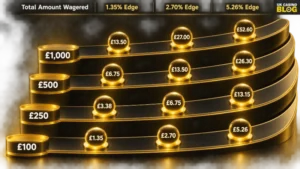
House edge represents the casino’s theoretical long-term advantage. It should not be interpreted as a prediction of exactly what someone will lose during one session.
Consider the theoretical exposure associated with different amounts of wagering:
| Total Amount Wagered | 1.35% Edge | 2.70% Edge | 5.26% Edge |
| £100 | £1.35 | £2.70 | £5.26 |
| £250 | £3.38 | £6.75 | £13.15 |
| £500 | £6.75 | £13.50 | £26.30 |
| £1,000 | £13.50 | £27.00 | £52.60 |
Actual short-term results can be dramatically higher or lower because roulette outcomes vary from spin to spin.
Can Roulette Strategies Improve Your Results Over Time?
Roulette systems can change how players manage stakes, but they cannot alter random results.
What Roulette Strategies Can Help With?
- Bankroll Structure
- Consistent Stake Sizing
- Session Planning
- Understanding Risk Exposure
- Avoiding Impulsive Bet Changes
What Roulette Strategies Cannot Do?
- Predict The Next Number
- Guarantee A Winning Session
- Remove The House Edge
- Make A Losing Number Due To Win
- Turn Roulette Into A Skill-Based Game
Why Previous Roulette Results Do Not Predict The Next Spin?
Roulette wheels do not have a memory.
If black appears several times consecutively, that does not mean red is automatically more likely on the following spin.
Understanding The Gambler’s Fallacy
The gambler’s fallacy occurs when someone believes previous independent outcomes change the probability of the next independent event.
A streak can look unusual without making the opposite outcome due.
Are Hot And Cold Numbers Useful?
Roulette interfaces commonly display recent results or numbers that have appeared frequently.
These statistics describe previous spins. They do not demonstrate that a number has become more or less likely to appear next.
Are Roulette Patterns Reliable?
Short-term sequences naturally contain clusters, streaks and repeated numbers.
A visible pattern is therefore not evidence that future roulette outcomes can be predicted.
Live Dealer vs RNG Roulette: Does Strategy Change In 2026?
Online roulette generally falls into two broad categories.
RNG Roulette
RNG roulette uses software to determine outcomes. UK Gambling Commission technical standards require applicable random number generation and game results to be acceptably random.
Because rounds can be completed quickly, players should pay attention to the number of bets they make rather than focusing only on the size of an individual wager.
Live Dealer Roulette
Live dealer roulette uses a physical wheel, with the game streamed to players.
The underlying strategy still depends on the wheel, payouts and table rules rather than whether a dealer is physically spinning the ball.
Does Game Speed Affect Your Bankroll?
A faster game does not necessarily have a worse percentage house edge.
However, placing more wagers in the same amount of time can increase total turnover, which increases the amount of money exposed to the house edge.
Do Strategies Work On Lightning And Multiplier Roulette?
Modern roulette games increasingly include multipliers, bonus mechanics and modified payouts.
Traditional systems such as Martingale and Fibonacci can still determine how much a player wagers, but the mathematics of the underlying game may differ from standard European roulette.
Before using any strategy on a multiplier game, check:
- Number Of Wheel Pockets
- Normal Straight-Up Payout
- Multiplier Rules
- Qualifying Bets
- Game-Specific House Edge
- Minimum And Maximum Stakes
Do not assume that a strategy calculated for standard European roulette transfers unchanged to every modern variant.
How To Choose The Best Roulette Strategy For You?
The most appropriate approach depends largely on how a player wants to manage stakes.
| Preference | Approach |
| Simple, fixed stakes | Flat Betting |
| Gradual negative progression | D’Alembert |
| Increasing bets after wins | Paroli |
| Sequence-based betting | Fibonacci |
| Aggressive progression | Martingale |
| Broad wheel coverage | James Bond |
These categories describe betting styles. They do not indicate that any one system can overcome the roulette house edge.
Common Roulette Strategy Mistakes To Avoid
Some of the biggest roulette mistakes have little to do with choosing the wrong named system.
- Chasing Losses: Increasing bets emotionally after losing can rapidly increase exposure
- Ignoring Table Limits: Progression systems can become impossible to continue when maximum stakes are reached
- Believing A Number Is Due: Previous independent spins do not force a future result
- Confusing Coverage With Profitability: Covering more numbers does not create a positive expectation
- Playing Faster To Recover Losses: More spins can simply increase total wagering
- Changing Systems After Every Loss: Short-term results do not prove that one system has stopped or started working
- Ignoring Total Turnover: Small individual bets can still add up to substantial wagering
How Can UK Players Use Roulette Strategies Responsibly In 2026?
Bankroll control should form part of any roulette strategy.
Players can set a fixed entertainment budget before beginning and avoid increasing that budget in response to losses.
Useful controls include:
- Financial Limits
- Session Limits And Reminders
- Time-Outs
- Account Transaction Reviews
- Self-Exclusion
- Taking Regular Breaks
The Gambling Commission introduced stronger financial-limit requirements in stages. Further rules due on 30 September 2026 require operators to offer gross deposit limits, with those limits receiving at least equal prominence to other financial-limit options.
GAMSTOP also provides free online self-exclusion for people in the UK who want to block access to licensed gambling websites and apps.
Final Thoughts
The best strategy on roulette is not a formula that guarantees winnings. Roulette remains a random game with a mathematical house advantage.
Players looking for better mathematical conditions should pay more attention to the wheel and game rules than to complicated betting progressions.
A single-zero wheel is generally preferable to a double-zero wheel, while La Partage can reduce the house edge on qualifying even-money bets.
Flat betting can help keep stakes predictable, while systems such as Martingale, Fibonacci and D’Alembert primarily change the pattern in which money is wagered.
Whichever approach is used, bankroll limits, realistic expectations and controlled wagering remain more important than trying to predict the next spin.
FAQs
What Is The Best Strategy On Roulette?
There is no roulette strategy that guarantees profit. Choosing favourable single-zero rules, keeping stakes controlled and limiting total wagering are more meaningful than relying on betting progressions.
What Is The Best Roulette Strategy For Beginners?
Flat betting is one of the simplest systems to understand because the same stake is used regardless of previous results.
What Is The Best Bet To Make In Roulette?
The answer depends on the player’s objective. Even-money bets win more frequently than inside bets, while qualifying La Partage even-money wagers can also carry a lower house edge.
Is There A Roulette Strategy That Always Wins?
No. Roulette is a game of chance and every betting system remains vulnerable to losing sequences.
Is European Or French Roulette Better?
Standard European roulette normally has a house edge of about 2.70%. French roulette offering La Partage can reduce the edge on eligible even-money bets to approximately 1.35%.
What Is The Safest Roulette Betting Strategy?
No roulette strategy is risk-free. Flat betting avoids the rapidly escalating stakes associated with systems such as Martingale and Grand Martingale.
Does Martingale Really Work On Roulette?
Martingale can recover previous losses when a winning even-money bet occurs before bankroll or table limits are reached. It does not improve the probability of the next spin and can require very large wagers after consecutive losses.
Can You Beat Roulette Mathematically?
Conventional roulette has a built-in house advantage. Betting progressions cannot remove that edge.
Does En Prison Reduce The House Edge?
Qualifying En Prison rules can reduce the disadvantage associated with even-money bets, although the precise treatment of an imprisoned wager should be checked in the individual game’s rules.
Is Live Roulette Better Than RNG Roulette?
Neither format is automatically better for strategy. The number of zeros, payout structure, special rules and game speed are more relevant considerations.
Do Roulette Strategies Work On Lightning Roulette?
Betting systems can still determine stake progression, but multiplier roulette may use different payouts and mechanics. Players should check the individual game’s rules rather than assuming standard roulette mathematics apply unchanged.
Can I Test Roulette Strategies For Free?
Some online operators provide free-play roulette. UK technical standards require corresponding play-for-free games to represent the rules and likelihood of winning of their play-for-money versions accurately.
Disclaimer
This content is provided for informational and educational purposes only. Roulette involves financial risk and no betting system can guarantee winnings.
Gambling should never be treated as a way to make money or recover financial losses. Only gamble with money you can afford to lose and use safer-gambling controls or support services if gambling becomes difficult to manage.