
How Many Numbers on a Roulette Wheel?
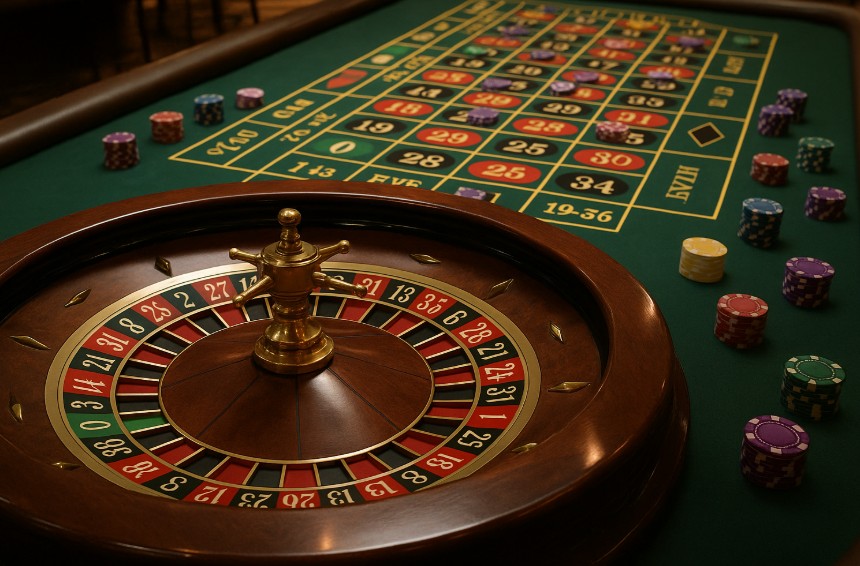
A standard European roulette wheel has 37 pockets: numbers 1 to 36 plus a single green 0.
An American roulette wheel has 38 pockets because it adds 00, while triple-zero roulette has 39 pockets with 0, 00 and 000. The highest regular number on every standard roulette wheel is 36.
The number of pockets matters because adding extra zeroes increases the house edge. However, the numbers themselves are only part of the story.
Their colour, position around the wheel, physical pocket design and the roulette variant being played all influence how the game is structured.
How Are Roulette Wheel Numbers Arranged?
Roulette wheel numbers do not appear in numerical order.
On a European wheel, the clockwise sequence from zero is:
0, 32, 15, 19, 4, 21, 2, 25, 17, 34, 6, 27, 13, 36, 11, 30, 8, 23, 10, 5, 24, 16, 33, 1, 20, 14, 31, 9, 22, 18, 29, 7, 28, 12, 35, 3, 26
The standard American sequence is:
0, 28, 9, 26, 30, 11, 7, 20, 32, 17, 5, 22, 34, 15, 3, 24, 36, 13, 1, 00, 27, 10, 25, 29, 12, 8, 19, 31, 18, 6, 21, 33, 16, 4, 23, 35, 14, 2
Triple-zero wheels contain 39 pockets, but players should not assume every triple-zero product follows one universal sequence. Modern manufacturers can offer different configurations, so the wheel displayed in the individual game’s rules should be treated as authoritative.
For anyone trying to understand how these wheel positions correspond with the rectangular betting grid, the roulette table layout shows how wheel numbers translate into inside, outside and sector-based wagers.
Why Aren’t Roulette Numbers in Numerical Order?
The apparently chaotic roulette number sequence is deliberate.
Putting 1 beside 2, then 3 beside 4 and continuing around the wheel would create large, easily recognised sectors containing similar numbers. Instead, traditional roulette wheels spread different characteristics around the circumference.
Colour Alternation
On the standard European wheel, red and black alternate around the numbered sequence.
The green zero sits outside the red-black system.
This means players do not encounter a long physical section of consecutive red or consecutive black pockets.
High And Low Number Distribution
Numbers from 1 to 18 are considered low, while 19 to 36 are high.
The European sequence distributes these groups around the wheel as evenly as practical rather than placing all low numbers on one side and high numbers on another.
The pattern is not perfectly alternating. One noticeable exception is the neighbouring pair 5 and 10, which are both low numbers. Around the zero, 26 and 32 are also both high, although zero separates them.
Odd And Even Distribution
Odd and even numbers are also dispersed around the wheel.
The European design avoids large uninterrupted clusters of odd or even outcomes, helping produce a visually mixed wheel rather than obvious numerical sectors.
Sector Disorientation
Another effect of the sequence is that the betting table and wheel look completely different.
Numbers beside each other on the table may sit far apart on the physical wheel. For example, 1, 2 and 3 form one row on the betting layout but occupy separate areas of the European wheel.
This makes physical wheel sectors considerably harder to visualise simply by looking at the numerical betting grid.
Importantly, the sequence does not make one pocket mathematically more likely than another on a properly operating wheel. It changes where the numbers are positioned, not the probability assigned to each pocket.
Which Roulette Numbers Are Red And Black?
Every standard roulette game divides numbers 1 to 36 equally between red and black.
There are:
- 18 Red Numbers
- 18 Black Numbers
- One Or More Green Zero Pockets
Red Roulette Numbers
The 18 red numbers are:
1, 3, 5, 7, 9, 12, 14, 16, 18, 19, 21, 23, 25, 27, 30, 32, 34, 36
Black Roulette Numbers
The 18 black numbers are:
2, 4, 6, 8, 10, 11, 13, 15, 17, 20, 22, 24, 26, 28, 29, 31, 33, 35
Green Numbers
The house pockets are green:
- 0 on European and French wheels
- 0 and 00 on American wheels
- 0, 00 and 000 on triple-zero wheels
A useful way to remember the red-black pattern is that from 1–10 and 19–28, odd numbers are red and even numbers are black. From 11–18 and 29–36, this reverses.
Where Did the Roulette Wheel Come From?
Modern roulette developed in France, although its precise origin combines several earlier games and wheel mechanisms.
Blaise Pascal is often connected with roulette because his 17th-century work on a perpetual-motion machine involved a spinning-wheel mechanism. The casino game itself developed later.
Roulette in a recognisably modern form was being played in Paris by the late 18th century, with an account from 1796 describing both zero and double-zero house pockets.
A major development arrived during the 19th century when François and Louis Blanc introduced a single-zero wheel at Bad Homburg. The reduced number of house pockets gave it a competitive advantage over double-zero games.
Single-zero roulette later became closely associated with Monte Carlo and much of Europe, while the double-zero format became established in the United States.
The difference created centuries ago remains important today because it explains why European and American roulette have different house edges.
What Parts Make Up a Physical Roulette Wheel?
A casino roulette wheel is considerably more sophisticated than a rotating bowl with numbered slots.
Several physical components influence how the ball travels before reaching its final pocket.
Ball Track
The ball initially travels rapidly around the outer track in the opposite direction to the rotating wheelhead.
As it loses speed, gravity causes it to move inwards.
Deflectors
Raised obstacles around the inner slope are commonly called deflectors, diamonds or ball stops.
The ball may strike one or more deflectors as it moves towards the numbered pockets, changing its path and adding physical uncertainty.
Frets Or Pocket Separators
Frets are the dividers separating adjacent pockets.
A slowing ball can hit a fret and bounce into another pocket rather than settling immediately.
Different wheel designs can use differently shaped or profiled separators.
Pocket Pads
The ball eventually settles in one of the numbered pockets. Depending on the design, the pocket base and surrounding materials are engineered to provide consistent behaviour and durability.
Wheelhead And Rotor
The numbered pockets form part of the rotating wheelhead or rotor.
High-quality roulette wheels are engineered carefully because small differences in balance, wear or alignment could potentially affect physical behaviour over a very large number of spins.
That is why professional equipment undergoes maintenance, calibration and quality-control procedures rather than being treated as a simple decorative casino prop.
Who Makes Professional Roulette Wheels?
Professional casino wheels are specialist pieces of gaming equipment rather than ordinary recreational wheels.
Two prominent manufacturers are Cammegh and TCSJOHNHUXLEY.
Modern designs demonstrate how much engineering goes into roulette. TCSJOHNHUXLEY, for example, offers roulette wheels with standard or Starburst separator rings, built-in sensors and multiple zero configurations.
Its current Saturn range can be supplied in single, double, triple and even quadruple-zero configurations.
Cammegh also produces casino and live-gaming roulette equipment. Its Mercury 360 RRS system can vary rotor deceleration to make wheel behaviour harder to predict through traditional wheel-clocking techniques.
Paulson is another historic casino-equipment name connected with table-game equipment and roulette-wheel supply through Gaming Partners International.
These developments matter because the modern casino industry is actively interested in maintaining consistent randomness and reducing the possibility that mechanical characteristics can be exploited.
Live Dealer Roulette Vs RNG Roulette: Are the Numbers Different?
The basic numbers usually remain familiar, but the mechanism producing the winning result is different.
Live Dealer Roulette
Live roulette normally uses an actual roulette wheel filmed from a casino floor or dedicated studio.
A croupier or automated system launches the ball, and the final result comes from the physical interaction between:
- Ball speed
- Rotor speed
- Ball track
- Deflectors
- Frets
- Pockets
Players watch that result through a live video stream.
RNG Roulette
RNG roulette does not require a physical spinning wheel to determine the result.
Instead, software generates the outcome through a random number generator. The animated wheel visible on screen represents that result.
For gambling software supplied to licensed British operators, UK Gambling Commission technical standards require random outcomes to be acceptably random and unpredictable.
RNG roulette therefore has no physical fret wear, ball-track condition or mechanical wheel bias to analyse.
The important comparison for a player remains the number of pockets and rules. An RNG European game can still have 37 outcomes and a 2.70% standard house edge, just as a physical European wheel does.
How Do Inside Bets Work?
Inside bets involve individual numbers or small groups within the numbered grid.
| Bet | Numbers Covered | Standard Payout |
| Straight Up | 1 | 35:1 |
| Split | 2 | 17:1 |
| Street | 3 | 11:1 |
| Corner | 4 | 8:1 |
| Six Line | 6 | 5:1 |
Other zero-related bets can depend on the wheel and table format.
For example, single-zero games may offer combinations around 0, 1, 2 and 3, while double-zero layouts can include combinations involving both 0 and 00.
Higher payouts do not mean a better mathematical advantage. They compensate for the lower probability of hitting the smaller group of numbers.
What Are Outside Bets?
Outside bets cover larger groups of the 1–36 numbers and therefore win more frequently than individual-number bets.
Common options include:
- Red Or Black covering 18 numbers
- Odd Or Even covering 18 numbers
- Low covering 1–18
- High covering 19–36
- Dozens covering 12 numbers
- Columns covering 12 numbers
Red/black, odd/even and high/low are often described as even-money bets because they pay 1:1.
However, they are not true 50/50 propositions because the green zero pockets are outside both sides of these wagers.
On European roulette, an 18-number even-money bet wins on 18 of 37 outcomes, equivalent to approximately 48.65%.
What Are Roulette Call Bets?
Traditional French and European roulette can include wagers based on physical sections of the wheel rather than rows or columns on the table.
These are known as call bets, announced bets or racetrack bets.
Voisins Du Zéro
Voisins du Zéro, meaning neighbours of zero, covers 17 numbers surrounding the zero section of the European wheel.
The sector is:
22, 18, 29, 7, 28, 12, 35, 3, 26, 0, 32, 15, 19, 4, 21, 2, 25
Traditional placement uses multiple inside bets rather than one single 17-number wager.
Tiers Du Cylindre
Tiers du Cylindre, or third of the wheel, covers 12 numbers approximately opposite zero:
27, 13, 36, 11, 30, 8, 23, 10, 5, 24, 16, 33
It is traditionally constructed using six split bets.
Orphelins
The Orphelins, or orphans, are the numbers not included in Voisins du Zéro or Tiers.
They are:
1, 6, 9, 14, 17, 20, 31, 34
Because these eight numbers sit in two separate sections of the wheel, the bet is spread across several placements.
Jeu Zéro
Jeu Zéro focuses more tightly on numbers immediately surrounding zero.
The usual numbers are:
12, 35, 3, 26, 0, 32, 15
Neighbour Bets
A neighbour bet centres on one selected wheel number plus nearby pockets.
A common version covers the chosen number and two physical neighbours on each side, producing five numbers in total.
This is based on wheel position, not numerical order.
Final Bets
Final or finale bets cover numbers sharing the same final digit.
For example:
Final 4 = 4, 14, 24 and 34
Final 7 covers:
7, 17 and 27
These wagers demonstrate why learning the physical roulette sequence has practical value even though it cannot predict the next winning number. Traditional call bets are built around where numbers sit on the wheel.
What Is A Complete Or Maximum Roulette Bet?
A complete bet is different from a sector bet.
Instead of covering neighbouring wheel numbers, it covers every qualifying inside bet connected with one chosen number.
That can include:
- Straight-Up Bets
- Split Bets
- Street Bets
- Corner Bets
- Six-Line Bets
The amount needed depends on where the chosen number sits on the rectangular table layout because central numbers participate in more combinations than edge numbers.
For example, traditional complete-bet structures may require substantially more units for centrally located numbers than for zero or numbers at the ends of the grid.
At high-limit tables, a player may announce a number “to the maximum”, with the casino using chips or special markers to represent the required collection of wagers.
Complete bets do not eliminate the house edge. They simply distribute a large stake across every eligible inside combination involving the chosen number.
What Are the Odds And Payouts in European Roulette?
On a European wheel with 37 pockets, the most common bets have the following probabilities:
| Bet | Numbers Covered | Win Probability | Payout |
| Straight | 1 | 2.70% | 35:1 |
| Split | 2 | 5.41% | 17:1 |
| Street | 3 | 8.11% | 11:1 |
| Corner | 4 | 10.81% | 8:1 |
| Six Line | 6 | 16.22% | 5:1 |
| Dozen | 12 | 32.43% | 2:1 |
| Column | 12 | 32.43% | 2:1 |
| Red/Black | 18 | 48.65% | 1:1 |
| Odd/Even | 18 | 48.65% | 1:1 |
| High/Low | 18 | 48.65% | 1:1 |
The payouts are calculated around 36 ordinary numbers even though a European wheel contains 37 possible pockets. That additional green zero is what produces the standard 2.70% house advantage.
What Is the House Edge on Different Roulette Wheels?
The number of zero pockets creates one of the biggest differences between roulette variants.
European Roulette
European roulette has 37 pockets and one zero.
Standard house edge: approximately 2.70%.
French Roulette
French roulette normally uses the same 37-pocket wheel.
Standard inside bets therefore still retain approximately the same 2.70% house edge.
However, the important difference comes from special rules.
La Partage
If zero lands while an eligible even-money bet is active, the player loses only half the stake.
This reduces the effective house edge on those qualifying wagers to approximately 1.35%.
En Prison
Instead of immediately losing the bet when zero appears, some tables hold or “imprison” the even-money stake until the following spin.
Exact treatment can depend on the rules being used, so players should check the individual table before betting.
American Roulette
American roulette contains both 0 and 00.
Standard house edge: approximately 5.26%.
Triple-Zero Roulette
Triple-zero roulette has 39 pockets.
Standard house edge: approximately 7.69%.
For players comparing different betting approaches, understanding this mathematical difference is more important than trying to find a betting progression that predicts the next result. The various approaches are covered more fully in the best strategy on roulette article.
Are Hot And Cold Roulette Numbers Real?
Roulette interfaces sometimes display hot numbers and cold numbers based on recent results.
A hot number is simply one that has appeared frequently during the recorded period. A cold number has appeared less frequently.
Neither label means the number has become more or less likely to win the next independent spin.
For example, if number 17 has appeared four times in the previous ten spins, its probability on the next properly random European roulette spin remains:
1 ÷ 37 = approximately 2.70%
Likewise, if 17 has not appeared for 100 spins, it does not become “due”.
Believing that a number must appear because it has been absent for a long time is a version of the gambler’s fallacy.
Past outcomes can be interesting statistics, but they do not change the probability of the next independent result.
How Often Does the Same Roulette Number Repeat?
Immediate repeats are perfectly possible.
On a European wheel, after one number has landed, the probability that the very next spin produces exactly the same pocket is:
1/37 = approximately 2.70%
On American roulette it is:
1/38 = approximately 2.63%
On a 39-pocket triple-zero wheel it is:
1/39 = approximately 2.56%
Therefore, seeing the same roulette number twice in succession is unusual but completely normal.
It also does not make a third repeat impossible. Each properly random spin begins again with the same set of possible outcomes.
Can Physical Roulette Wheels Develop Bias?
Historically, imperfect physical roulette wheels created opportunities for people who collected huge amounts of spin data.
A worn bearing, uneven pocket, slight tilt or other mechanical imperfection could theoretically cause some physical sectors to occur more frequently than expected.
Modern professional wheels, however, are engineered and maintained specifically to minimise such effects.
Electronic monitoring, precise manufacturing, sensors, specialised separator systems and technologies that alter rotor behaviour can make traditional wheel-clock or sector-prediction techniques considerably harder to exploit.
Cammegh’s Random Rotor Speed technology, for example, is specifically designed to increase unpredictability against wheel clocking and advantage play.
For ordinary players, recorded hot and cold numbers should therefore not be treated as evidence that a licensed casino wheel can be beaten.
Famous Examples of Players Studying Roulette Wheels
Roulette’s physical mechanics have produced several famous stories.
Joseph Jagger And Wheel Bias
Joseph Jagger became associated with one of roulette’s most famous advantage-play stories after studying results from roulette wheels in Monte Carlo during the 19th century.
The principle was very different from Martingale-style betting. Instead of assuming previous wins or losses predicted future outcomes, the approach attempted to identify whether a particular physical wheel was mechanically biased.
The story remains a useful distinction between statistical superstition and genuine mechanical advantage play.
The Ritz Casino Case

In 2004, three gamblers attracted widespread attention after winning around £1.3 million playing roulette at London’s Ritz.
Reports alleged that technology involving a laser scanner and computer calculations had been used to estimate the likely sector in which the ball would land by measuring physical characteristics of the spin.
After an investigation, police took no further action and the gamblers were reportedly allowed to keep the winnings.
The incident illustrates why modern wheel makers and casinos pay close attention to equipment security, betting cut-off times and prediction technology.
Ashley Revell’s Single Roulette Bet
Another famous roulette story involved British gambler Ashley Revell, who sold his possessions and placed his available bankroll on a single red-or-black roulette wager in Las Vegas in 2004.
The ball landed on red and the bet won.
The story is memorable, but it does not demonstrate a winning roulette strategy. A single successful result does not change the long-term mathematics of the wheel.
How Should the Roulette Wheel Affect Betting Decisions?
The most useful information a roulette wheel gives a player is not which number will appear next. It is the game’s mathematical structure.
Prefer Fewer Zeroes
A single-zero game gives the casino a smaller mathematical advantage than double-zero or triple-zero roulette.
Check French Rules
A French or European game offering La Partage on even-money wagers can reduce the house edge on those bets to approximately 1.35%.
Understand What Betting Systems Can And Cannot Do
Martingale, Fibonacci, D’Alembert and other systems can change stake progression.
They cannot alter the probability that the ball lands in a particular pocket.
Avoid Chasing Hot Or Cold Numbers
A recent results board describes what has already happened.
It does not reliably predict the next independent spin.
Set A Fixed Gambling Budget
Roulette has a built-in house advantage regardless of the betting system being used.
Players should decide what they are prepared to lose before playing and should never increase stakes simply to recover previous losses.
Conclusion
So, how many numbers are on a roulette wheel? The standard answer for UK and European-style roulette is 37 pockets: 0 plus numbers 1 to 36. American roulette increases this to 38 by adding 00, while triple-zero roulette reaches 39.
The number count matters because each additional zero increases the casino’s mathematical advantage.
European and French single-zero wheels therefore generally offer better underlying odds than American or triple-zero versions.
Beyond the count, the wheel’s non-sequential number order, alternating colours, physical sectors, deflectors, frets and specialised call bets reveal why roulette is more carefully designed than its simple appearance suggests.
What the wheel cannot provide is a reliable prediction of the next winning number. Hot numbers, cold numbers and previous sequences do not change the probability of an independent spin.
FAQs About Roulette Wheel Numbers
How Many Numbers Are on a Roulette Wheel?
European and French roulette have 37 pockets covering 0 to 36. American roulette has 38 pockets after adding 00, while triple-zero roulette has 39.
What Is the Highest Number on a Roulette Wheel?
The highest regular roulette number is 36. This does not change between European, French, American or triple-zero roulette.
How Many Red Numbers Are on a Roulette Wheel?
There are 18 red numbers between 1 and 36.
How Many Black Numbers Are on a Roulette Wheel?
There are 18 black numbers between 1 and 36.
Is Zero Red Or Black in Roulette?
Neither. Zero is green. Double zero and triple zero are also normally displayed as green house pockets.
Why Are Roulette Numbers Not in Order?
The sequence distributes colours, high and low values, and odd and even numbers around the physical wheel instead of creating simple numerical sectors.
Are European And French Roulette Wheels the Same?
Both normally use a 37-pocket single-zero wheel. The main difference is that French roulette can include rules such as La Partage or En Prison.