
Bruno Mars Gambling Losses: What’s Real and What’s Denied?
There is no verified evidence that Bruno Mars lost $50 million gambling or owed that amount to MGM Resorts. The $50 million figure was an anonymously sourced allegation, and MGM publicly denied it.
Claims that Bruno Mars owed MGM Resorts as much as $50 million in gambling debt became one of the most repeated celebrity casino stories of 2024. However, the available public evidence does not support presenting that figure as fact.
The allegation originated in a March 2024 NewsNation report relying on an unnamed “Vegas insider”. MGM Resorts International, the company supposedly owed the money, then issued an unequivocal denial. It said the speculation was “completely false” and that Mars had “no debt with MGM”.
Mars has since referred to the story in humorous social-media posts, but those jokes are not evidence that the alleged debt existed.
Where Did the $50 Million Bruno Mars Gambling Rumour Begin?
The story took off after NewsNation reported on 14 March 2024 that Mars allegedly owed millions of dollars to MGM. Its unnamed source claimed the total had reached as high as $50 million and suggested that income from his Las Vegas performances was being used to repay it.
The same source also made claims about Mars’s annual earnings and what he supposedly retained per show. Those numbers were repeated across entertainment websites and social platforms, often without the original sourcing caveat. Forbes described the report as anonymously sourced and noted that MGM denied any such debt existed.
Anonymous sourcing can be legitimate, but a serious financial allegation requires corroboration. No public evidence was produced to establish the balance, repayment arrangement or alleged link between gambling and Mars’s residency.
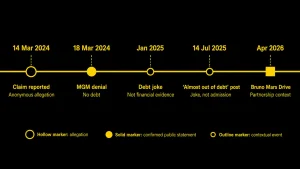
Bruno Mars Gambling-Rumour Timeline
| Date | Development | Evidence status |
| 14 March 2024 | NewsNation published the claim that Mars allegedly owed up to $50 million to MGM. | Anonymous-source allegation |
| 18 March 2024 | MGM Resorts said Mars had no debt with the company and called contrary speculation false. | On-record denial from the alleged creditor |
| January 2025 | Mars joked that continued music streaming would help him get “out of debt”. | Humorous social-media reference, not financial evidence |
| 14 July 2025 | Mars posted “Almost out of debt” after appearing with Rosé at a BLACKPINK concert. | Another joke referencing the rumour |
| April 2026 | Mars was publicly celebrated in Las Vegas, with a street named Bruno Mars Drive as his relationship with the city continued. | Public partnership context; not proof of private finances |
The April 2026 development does not prove anything about private finances, but it shows that the public relationship remained celebratory rather than adversarial.
What Exactly Did MGM Resorts Deny?

MGM Resorts International did more than issue a vague “no comment”. Its statement directly addressed the central allegation.
The company said its partnership with Mars was longstanding and based on mutual respect. Most importantly, it stated that he had no debt with MGM and that speculation suggesting otherwise was false. The statement referred to his shows at Dolby Live at Park MGM and his entertainment involvement with The Pinky Ring at Bellagio.
This distinction matters because some coverage loosely referred to “MGM Grand”, “the casino” or “MGM Casino” as though they were interchangeable. The denial came from MGM Resorts International, the parent hospitality and entertainment company at the centre of the allegation.
Mars’s performances were associated with Dolby Live at Park MGM, while The Pinky Ring is located at Bellagio. Readers researching the wider brand should therefore avoid confusing a celebrity rumour about US resort operations with online-gambling products or general information about MGM casino services online.
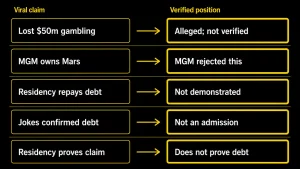
Claim Versus Verified Information
| Viral claim | What can responsibly be reported |
| “Bruno Mars lost $50 million gambling.” | A report alleged a debt as high as $50 million. No verified public evidence established that he lost this amount. |
| “MGM owns Bruno Mars.” | This was attributed to an unnamed source. MGM rejected the characterisation and described the partnership as mutually respectful. |
| “His residency income is paying off casino debt.” | That repayment arrangement was alleged, not demonstrated. MGM said no debt existed. |
| “Mars confirmed it by saying he was almost out of debt.” | His wording appeared in playful posts after the rumour was already widely known. A joke is not a financial admission. |
| “His long Las Vegas residency proves the story.” | A long commercial relationship can have many ordinary explanations. Its duration does not prove an undisclosed debt. |
The safe editorial formulation is therefore not “Mars had a $50 million gambling loss”. It is: Mars was the subject of a $50 million gambling-debt allegation that MGM Resorts denied.
Did Bruno Mars Admit to Gambling Losses?

Mars has not publicly authenticated the $50 million claim. Instead, he has repeatedly leaned into the internet joke.
In January 2025, after celebrating a major streaming milestone, he jokingly encouraged fans to keep streaming so he would be out of debt. In July 2025, an Instagram post after his appearance with Rosé included the phrase “Almost out of debt”. The July caption came from Mars’s verified Instagram account.
Those remarks may keep the rumour visible, but context is decisive. They came after MGM’s formal denial and were written as exaggerated, playful captions tied to career success. Treating them as literal admissions would ignore both their tone and chronology.
Public figures often reuse rumours as jokes. That does not convert the underlying allegation into fact; a genuine admission would require clear, literal confirmation.
Why Did the Story Spread So Quickly?
The rumour mixed a globally recognised musician, Las Vegas casinos, a huge round-number figure and the dramatic suggestion that a corporation controlled an artist’s career. It was easy to compress for social media, while the qualifier “an unnamed source alleged” was often lost.
Mars’s visible Las Vegas association made the story feel plausible, but plausibility is not proof. A residency, casino setting and debt jokes do not establish that a particular transaction occurred.
Once the claim began appearing across multiple websites, readers could easily mistake the number of articles for the number of sources. In reality, many reports were repeating the same underlying allegation rather than providing independent confirmation.
This is an important distinction when assessing viral celebrity news. Ten articles citing one anonymous report do not amount to ten separate pieces of evidence.
How Strong Is the Evidence Behind Each Part of the Story?
| Information | Source type | Evidential strength | Appropriate wording |
| MGM said Mars had no debt with it | Named company statement | Strong evidence of MGM’s official position | “MGM denied the debt allegation” |
| The $50 million figure was reported | Unnamed source quoted by a news outlet | Weak without independent corroboration | “An anonymous source alleged” |
| Mars joked about being in debt | Posts from his verified social account | Strong evidence that he made the joke; weak evidence of an actual debt | “Mars mocked the rumour” |
| Mars performed at MGM venues | Public event and venue records | Strong evidence of a commercial relationship | “Mars had a longstanding MGM partnership” |
| The residency existed to repay gambling losses | Inference built on the anonymous allegation | Unsupported as a confirmed conclusion | Do not state as fact |
An official statement establishes MGM’s position, not access to every private record. Equally, repetition cannot elevate an anonymous allegation into certainty.
The balance of available evidence is clear: the alleged creditor denied the debt, Mars did not confirm it and no credible public documentation has substantiated the $50 million figure.
Does Mars’s Continuing MGM Relationship Settle the Question?
MGM’s newsroom continued to associate Mars with Dolby Live at Park MGM in 2026, while current venue information directs guests from Bruno Mars Drive.
This public relationship conflicts with the rumour’s most sensational “trapped by debt” framing, but event listings cannot reveal private accounts. They provide context, not an audit.
The continuing relationship is consistent with MGM’s description of a commercially successful and mutually respectful partnership. It is not, however, necessary to use that relationship as the principal rebuttal.
The strongest evidence remains MGM’s direct statement that Mars did not owe the company money.
What Should Readers Avoid Assuming?
Celebrity earnings or net-worth estimates should not be treated as cash available to pay a supposed debt. Gross revenue, performance fees, taxes, production costs and personal wealth are different concepts, and no reliable calculation is possible without contracts and accounts.
A casino residency is also not evidence of gambling harm. Las Vegas residencies are commercial entertainment arrangements involving venues, promoters, production teams and ticket sales. Their length does not prove that an artist is repaying casino losses.
A humorous caption should not be stripped of context either. Mars’s “almost out of debt” language followed MGM’s explicit denial and matched his wider pattern of teasing the rumour.
The responsible conclusion is not that every private detail about Mars’s finances or gambling activity is known. It is that the specific $50 million MGM claim remains unverified and was directly denied.
Why Precise Wording Matters?

The difference between “reported”, “alleged”, “denied” and “confirmed” is not cosmetic. Each word tells the reader how much evidence exists.
Saying Mars “lost $50 million” removes the uncertainty and wrongly converts an accusation into a fact. Saying “a report alleged that he owed up to $50 million, which MGM denied” preserves both the origin and the strongest response.
This is especially important when a story concerns personal finances, addiction or contractual pressure. Loose wording can unfairly damage a person’s reputation and can also mislead readers about how gambling debt, entertainment contracts and casino relationships work.
Responsible coverage should repeat only the detail needed to explain the rumour, then give the denial equal or greater prominence.
Responsible-Gambling Context for UK Readers
Celebrity stories can make extreme losses sound entertaining. Real gambling-related harm can affect finances, wellbeing, relationships and work.
UK readers concerned about their own play can review how financial risk checks operate in the regulated British market and read about treatment options for gambling-related harm.
Family members or friends may also find the guide to supporting someone affected by gambling useful.
The helpline is available free of charge, 24 hours a day, on 0808 8020 133 in England and Scotland.
Responsible-gambling disclaimer: This article reports on a disputed celebrity claim and does not assess or diagnose any individual’s gambling behaviour. Anyone experiencing financial distress or loss of control related to gambling should seek confidential professional support.
Final Verdict
The phrase “Bruno Mars gambling losses” attracts searches because the $50 million story spread widely. Yet repetition is not verification.
An unnamed source made the allegation, MGM denied it and Mars later turned it into a joke. No reliable public evidence has established the loss, a debt-controlled career or a residency repayment scheme.
The publishable conclusion should therefore remain cautious and precise: the $50 million gambling-loss claim is an unverified rumour that MGM Resorts has explicitly denied.
FAQs About Bruno Mars gambling Dept
How much did Bruno Mars lose gambling?
No verified amount has been established publicly. The widely repeated $50 million number came from an anonymous-source allegation about debt to MGM Resorts. MGM said Mars had no debt with the company.
Does Bruno Mars owe MGM $50 million?
MGM Resorts’ official position is no. It directly denied the allegation in March 2024 and said that Mars had no debt with MGM. No credible public documentation reviewed for this article has subsequently verified the claimed balance.
Why does Bruno Mars joke about being in debt?
The jokes appear to be his way of playing with a viral internet story. His comments about getting out of debt appeared after MGM had denied the allegation and were attached to celebratory career posts. They should not be presented as admissions.
Was Bruno Mars forced to perform in Las Vegas to repay MGM?
There is no verified evidence supporting that claim. It originated as part of the same anonymously sourced report, while MGM described the relationship as longstanding and mutually respectful.
Did MGM Grand deny the Bruno Mars rumour?
More precisely, MGM Resorts International issued the denial. Coverage sometimes used “MGM Grand” or “MGM casino” loosely, but the statement addressed Mars’s relationship with MGM Resorts and referenced Park MGM and Bellagio.
Is Bruno Mars known to gamble?
The $50 million story does not prove anything broader about Mars’s personal gambling habits. Reports about a person enjoying poker or spending time in casinos would not, on their own, establish a debt, addiction or specific loss.
It is safer to avoid diagnosing behaviour or inferring financial harm from venue associations.
Is the Bruno Mars gambling-loss story fake?
The most accurate description is unverified and officially denied. A news report made the allegation, but MGM Resorts said it was false. Calling it a confirmed gambling loss would therefore be inaccurate.
Did Bruno Mars’s “almost out of debt” post change the evidence?
No. It confirmed that Mars was willing to joke about the rumour, but it did not confirm the alleged debt. The post did not include financial records, repayment details or a literal statement accepting the original allegation.