The Evolution of Casino Bonuses in the UK Market
Casino bonuses in the UK have not changed overnight. They have shifted gradually, shaped by regulation, competition, and the ways in which online casino platforms are now built and explained.
For a long time, bonuses were one of the simplest tools available to UK online casinos. They were easy to advertise, easy to repeat, and familiar to users who were still getting used to gambling online.
A matched deposit or similar incentive helped new sites look competitive without needing much explanation. That approach worked when the market was smaller. It worked when there were fewer operators and fewer rules around how incentives had to be described.
It works far less well now. As the UK market expanded, bonuses had to adapt accordingly. What exists today is not just a larger version of early offers but something organised very differently.
Why Have UK Casino Bonuses Shifted From Big Promises to Structured Rewards?
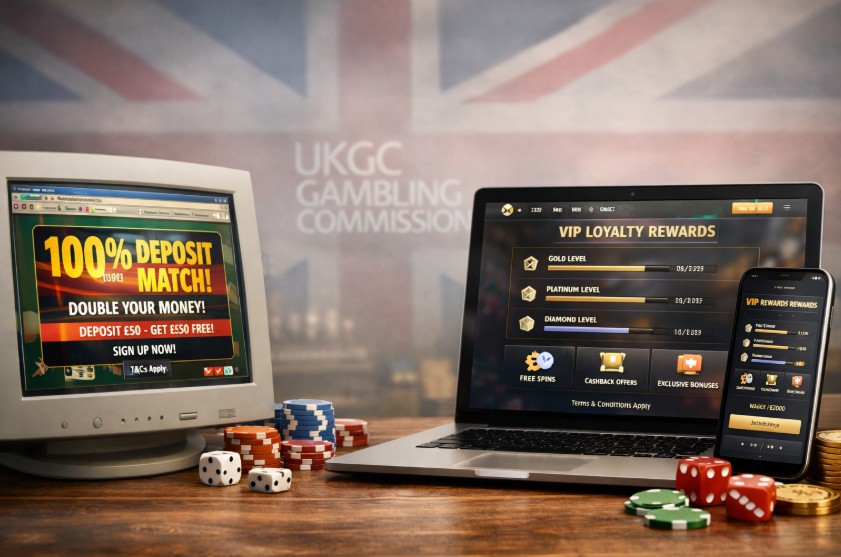
Early Online Casino Bonuses and Simple Deposit Matches

In the early days of UK online casinos, most bonus offers were similar. A deposit match was the default option. Deposit funds and receive a matching amount up to a limit. The details rarely stood out because they did not need to.
There was little incentive for creativity. If one site offered a 100 per cent match, the next would do the same. Differences between platforms were minor and often unrelated to bonuses themselves. At that stage, visibility mattered more than distinctiveness.
Terms and conditions existed, but they were not always front and centre. For many users, the headline number carried more weight than the actual workings of an offer. That was accepted at the time because expectations were different.
As the market grew, that simplicity became harder to maintain. UK Gambling Commission figures show that the remote casino, betting and bingo sector generated £6.9 billion in gross gambling yield during the 2023–24 financial year.
That scale helps explain why bonus structures have become more regulated and more standardised, with operators operating in a market where small design choices are closely scrutinised.
Regulation and the Shift Toward Transparent Bonus Terms
Bonus offers did not change because operators suddenly chose to simplify them. They changed because the surrounding space tightened. As the UK online gambling market settled into a regulated routine, how bonuses were shown became as important as what they offered.
That shift shows up clearly in the UK Gambling Commission’s 2024 compliance and enforcement reporting. The regulator restated that key bonus conditions, including wagering requirements and restrictions, should be visible at the same point as the offer itself.
In other words, the details could no longer be set aside. If an incentive existed, its limits had to exist beside it. For casinos, that requirement reshaped how bonuses were put together. Large headlines lost some of their usefulness if the conditions were immediately visible.
That approach became even more structured from 19 January 2026, when new Gambling Commission rules came into force limiting wagering requirements on bonus funds to a maximum of 10 times.
For example, a £10 bonus subject to the maximum requirement could require up to £100 in wagering before the relevant bonus funds become withdrawable.
The change places a clear regulatory ceiling on a condition that historically varied considerably between promotions, making wagering requirements easier for players to understand and compare.
Over time, many platforms responded by adjusting tone rather than size. Language became flatter. Formatting became more uniform. Bonus designs moved away from spectacle and toward something that could be read quickly without explanation.
What emerged was not fewer bonuses, but quieter ones. Incentives remained part of the market, but they were framed in a way that reflected tighter oversight and a more settled set of expectations.
From Welcome Bonuses to Structured Reward Systems

As regulations tightened, many operators started to move away from one-off welcome bonuses as their main incentive. The focus shifted toward systems that extended beyond sign-up.
Loyalty points, tier systems, and recurring rewards became more common. Rather than offering everything at the outset, platforms began distributing incentives over time. Progress tracking and unlockable features followed, borrowing ideas from other regulated digital services.
Modern reward structures are also subject to tighter limits on how different gambling products can be combined.
Since 19 January 2026, UK-licensed operators cannot structure a single incentive so that customers are required to participate in more than one type of gambling product, such as combining betting and casino play within the same promotion.
This means bonus design is increasingly shaped not only by competition and retention strategies but also by rules intended to keep individual promotions clearer and less complex.
This shift is also evident in how bonus information is organised. Pages on Casino.co.uk show how modern incentives are grouped by category rather than presented as a single headline offer.
A page such as “Best Online Casino Bonuses and Offers in the UK 2025″ presents different bonus types side by side, distinguishing welcome offers from ongoing promotions and loyalty schemes.
That layout reflects how incentives now function in practice, as part of a broader structure rather than isolated features. The emphasis is no longer on a single moment of entry. It is about how different rewards fit together across a platform.
What Modern Bonus Design Says About the UK Market?

Modern bonus design reflects a market that has settled into clearer rules. Incentives are now built into platforms from the start, rather than added later for marketing impact. While bonus systems contain more detail than they once did, they are also easier to compare across sites.
This aligns with broader industry patterns. Statista’s 2024 European online gambling analysis indicates a stronger emphasis on retention-based models, in which ongoing engagement is more important than one-time offers.
A 2024 academic review in the Journal of Digital Consumer Behaviour also found that gamified reward progression is now common across regulated digital platforms, not just gambling services.
In that context, casino bonuses function less as attention-grabbers and more as structural features. Their design reflects how operators respond to regulation, competition, and users who are more familiar with how online casinos work.
The move away from oversized, one-off offers suggests a market that is no longer seeking to grow at any cost but is adapting to long-term oversight.