What Casino Games Have the Best Odds?
Casino games with the best odds are generally full-pay video poker, blackjack played with basic strategy, the Banker bet in baccarat, selected craps bets and French or European roulette. However, there is no casino game that guarantees a profit.
The precise odds depend on the game’s rules, paytable, bet type and, in some cases, the decisions made by the player.
A blackjack table paying 3:2 for blackjack may offer substantially better value than a version paying 6:5. Likewise, the Banker bet in baccarat has a much lower house edge than the Tie bet, even though both are offered in the same game.
For that reason, the most useful way to compare casino games is through the house edge and return to player, rather than simply asking how frequently one round might produce a win.
Important: The percentages in this guide are long-term mathematical averages. They do not predict what will happen during an individual session.
Gambling should never be treated as a source of income or a way to recover financial losses. Players must be aged 18 or over in Great Britain.
Top 10 Casino Games and Bets with the Best Odds
The following casino games and individual bets generally offer some of the lowest mathematical house advantages available. The quoted percentages are theoretical long-term averages and depend on the exact rules, paytable and playing strategy.
A low house edge does not guarantee that a player will win. It only shows that the casino’s expected mathematical advantage is comparatively smaller over a very large number of wagers.
1. Full-Pay Jacks or Better Video Poker
House edge: 0.46%
Theoretical RTP: 99.54%
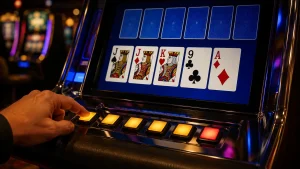
Full-pay Jacks or Better video poker can offer one of the highest theoretical returns in a casino. However, the 99.54% RTP applies specifically to a 9/6 paytable, which normally pays nine times the stake for a full house and six times the stake for a flush.
The figure also assumes that every hand is played using optimal video poker strategy. Players must decide which cards to hold and which to discard, and even small strategic errors can reduce the effective return.
Not every Jacks or Better machine uses the same paytable. An 8/5 or 7/5 version may look almost identical but offer a noticeably lower RTP.
Players comparing video poker with other card-based casino options may also find it useful to review the available online poker sites and game formats, although traditional poker and video poker use different rules and payout structures.
Main condition: The game must use a full-pay 9/6 table, and the player must make mathematically optimal decisions.
2. Blackjack

House edge: approximately 0.3%–1%
Theoretical RTP: approximately 99%–99.7%
Blackjack is one of the strongest widely available casino games when it combines favourable table rules with accurate basic strategy.
Unlike roulette or baccarat, blackjack allows the player’s decisions to influence the mathematical return. Choices such as whether to hit, stand, double down or split can either reduce or increase the casino’s advantage.
The exact house edge depends on several rules, including:
- whether blackjack pays 3:2 or 6:5;
- whether the dealer stands on soft 17;
- how many decks are used;
- whether doubling after splitting is permitted;
- whether surrender is available.
A table paying 3:2 for blackjack will normally be more favourable than a similar table paying 6:5. Side bets and insurance should be assessed separately because they usually have a higher house edge than the main blackjack hand.
A player learning the decision-making process can use this blackjack basic strategy guide to understand when the mathematically preferred action is to hit, stand, split or double.
Main condition: The table must offer favourable rules, and the player must follow accurate basic strategy.
3. Baccarat Banker Bet

House edge: 1.06%
Theoretical RTP: 98.94%
The Banker bet in baccarat is one of the simplest low-house-edge options because the game’s drawing rules are automatic. Once the wager has been placed, the player does not need to decide whether another card should be drawn.
The Banker hand wins slightly more often than the Player hand because of the game’s fixed third-card rules. Conventional baccarat therefore normally deducts a commission from winning Banker bets.
Even after accounting for the standard commission, the Banker bet retains a lower house edge than the Player bet. It is also significantly more favourable than the baccarat Tie bet and most pair side bets.
The Banker bet is not guaranteed to win more frequently during a short session. Its advantage only becomes meaningful when results are considered across a very large number of rounds.
Readers comparing baccarat with other dealer-led formats can explore this overview of online casino table games to understand how rules and player decisions differ between games.
Main condition: The figures apply to conventional commission baccarat rather than every no-commission or altered-payout variant.
4. French Roulette Even-Money Bet

House edge: 1.35%
Theoretical RTP: 98.65%
French roulette can provide better odds than standard European roulette when the table applies la partage or en prison to even-money bets.
Even-money wagers include:
- red or black;
- odd or even;
- high or low.
Under la partage, only half of an even-money stake is lost when the ball lands on zero. Under en prison, the affected stake may remain in place for the following spin, depending on the table rules.
These protections reduce the effective house edge on qualifying bets from 2.70% to approximately 1.35%.
The reduced percentage does not normally apply to straight-up numbers, splits, streets, corners or other inside bets. Players must therefore confirm exactly which wagers are covered by the special rule.
Those unfamiliar with the betting areas can first review the roulette table layout to see how inside and outside wagers are positioned.
Main condition: La partage or en prison must apply to the selected even-money wager.
5. Craps Don’t Pass or Don’t Come

House edge: 1.36%
Theoretical RTP: 98.64%
The Don’t Pass and Don’t Come bets are among the lowest-house-edge base wagers on a standard craps table.
A Don’t Pass bet is normally placed before the come-out roll. It wins immediately when the first roll is 2 or 3, loses when the result is 7 or 11 and pushes when the result is 12 under common rules. If a point is established, the bet wins when 7 appears before the point number repeats.
The Don’t Come bet follows similar mathematics but is placed after a point has been established.
Although the house edge is slightly lower than the Pass Line, some players prefer the Pass side because it aligns with most of the table’s other participants. That social distinction does not change the underlying probabilities.
The sequence of rolls and point numbers can be easier to follow after reading the full craps game rules.
Main condition: The percentage applies to the standard base bet and does not include unrelated proposition or side bets.
6. Craps Pass Line or Come
House edge: 1.41%
Theoretical RTP: 98.59%
The Pass Line is one of the best-known wagers in craps and offers a comparatively low house edge.
On the come-out roll, a Pass Line bet normally wins when the result is 7 or 11 and loses when the result is 2, 3 or 12. Any other qualifying number becomes the point. The player then wins if the point is rolled again before a 7.
A Come bet uses a similar structure but is made after a point has already been established.
Players may also be allowed to take odds behind a Pass Line or Come bet. The additional odds portion is commonly paid at true mathematical odds, although the original base bet still retains its house edge and the total amount at risk increases.
A step-by-step explanation of the table sequence is available in this guide to playing craps for beginners.
Main condition: The 1.41% figure applies to the standard Pass Line or Come base bet.
7. Pai Gow Poker
House edge: approximately 1.46%
Theoretical RTP: approximately 98.54%
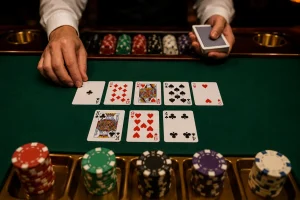
Pai Gow Poker is played with seven cards that must be divided into a five-card high hand and a two-card low hand. The player’s two hands are then compared with the dealer’s corresponding hands.
To win the round, the player generally needs to beat both dealer hands. If the player wins one comparison but loses the other, the result is usually a push and the main stake is returned.
This structure creates more pushes than many other casino card games, which can result in a slower pattern of wins and losses. However, frequent pushes should not be confused with a player advantage.
The precise house edge can depend on commission rules, how the dealer sets their hand and whether the player correctly arranges their own cards. Optional side bets have separate and usually less favourable odds.
Readers who want to understand the hierarchy used in poker-style games can consult this guide to poker hand rankings.
Main condition: Standard commission rules and competent hand setting are required for the quoted figure.
8. Ultimate Texas Hold’em

House edge: approximately 2.19%
Theoretical RTP: not directly comparable
Ultimate Texas Hold’em is a casino table game in which the player competes against the dealer rather than other players. The player can increase the Play bet at different stages after seeing some or all of the available cards.
The commonly quoted house edge of approximately 2.19% is calculated relative to the initial Ante under a particular mathematical convention. It should not automatically be converted into a simple 97.81% RTP because several wagers may be placed during a single hand.
A player may have the opportunity to place a larger Play bet before the community cards are revealed or wait and place a smaller bet later. These decisions affect the game’s theoretical result.
The Trips side bet uses a separate paytable and is not included in the main-game house-edge figure.
The betting stages and dealer qualification rules are explained in more detail in this guide to live-dealer Ultimate Texas Hold’em.
Main condition: The player must use optimal strategy, and the 2.19% figure should be understood as an Ante-based calculation rather than a directly comparable whole-game RTP.
9. European Single-Zero Roulette

House edge: 2.70%
Theoretical RTP: 97.30%
European roulette uses a wheel with 37 pockets: numbers 1 to 36 and a single zero.
The single zero gives the casino a house edge of approximately 2.70% on standard wagers. This applies to both inside bets, such as individual numbers, and outside bets, such as red or black, unless a special half-loss rule is available.
European roulette offers better mathematical odds than American roulette, which normally includes both a single zero and a double zero. The additional zero increases the American roulette house edge on most wagers to approximately 5.26%.
The payout size changes between roulette bets, but the underlying house edge generally remains 2.70% on a standard single-zero table.
A fuller explanation of the wheel, payouts and available wagers can be found in the guide to European roulette. Readers should also note that popular roulette betting strategies cannot remove the mathematical effect of the zero.
Main condition: The wheel must contain one zero rather than both 0 and 00.
10. High-RTP Online Slot

House edge: approximately 3%–4%
Theoretical RTP: approximately 96%–97%
A high-RTP slot can offer a theoretical return of around 96% to 97%, leaving a corresponding house edge of approximately 4% to 3%.
However, slots do not share one universal return percentage. Two games with similar themes, graphics or bonus features may have very different RTP settings.
For example:
- a 97% RTP produces a theoretical house edge of 3%;
- a 96% RTP produces a theoretical house edge of 4%;
- a 94% RTP produces a theoretical house edge of 6%.
The published RTP is calculated over a very large number of spins. It does not mean that a player staking £100 will receive exactly £96 or £97 back during one session.
Volatility must also be considered. A high-volatility slot may deliver fewer but larger prizes, while a lower-volatility slot may produce smaller wins more frequently. Volatility changes the distribution of results, not the published long-term RTP.
Players comparing titles can use this analysis of which online slots have the highest advertised payout percentages.
It is also important to understand that no legitimate technique can guarantee success on slot machines, despite claims about winning consistently on casino slots.
Main condition: The individual game must display an RTP of approximately 96% to 97%, as different versions of the same slot may use different settings.
What Do House Edge and RTP Actually Mean?
House edge represents the casino’s theoretical long-term advantage. RTP expresses the other side of approximately the same calculation in games where the two measures are directly comparable.
For example:
100% − 2.70% European roulette house edge = 97.30% theoretical RTP.
Neither percentage predicts a short session. A player can win despite choosing a high-edge game or lose immediately on a low-edge game. The difference becomes meaningful across large amounts of total betting activity.
The Gambling Commission requires remote games to provide information enabling customers to understand their chances before gambling. Depending on the game, that information may include the house edge, theoretical RTP or probability of particular winning events.
How Much Difference Does the House Edge Make?
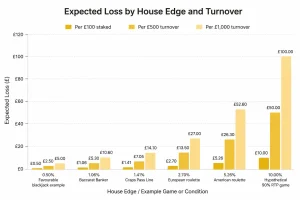
The following table shows the theoretical average loss at different levels of turnover. Turnover means the total amount repeatedly staked, not merely the opening deposit.
| House edge | Example game or condition | Expected loss per £100 staked | Per £500 turnover | Per £1,000 turnover |
| 0.50% | Favourable blackjack example | £0.50 | £2.50 | £5.00 |
| 1.06% | Baccarat Banker | £1.06 | £5.30 | £10.60 |
| 1.41% | Craps Pass Line | £1.41 | £7.05 | £14.10 |
| 2.70% | European roulette | £2.70 | £13.50 | £27.00 |
| 5.26% | American roulette | £5.26 | £26.30 | £52.60 |
| 10.00% | Hypothetical 90% RTP game | £10.00 | £50.00 | £100.00 |
These are mathematical expectations across repeated play, not charges deducted from every session. Actual results may be dramatically different.
Game speed also matters. A low house edge applied to hundreds of rapid bets can generate more theoretical loss than a somewhat higher edge applied to a small number of bets.
Ten Checks Before Choosing a Casino Game
- Find the published RTP or house edge. The information should be available before real-money play begins.
- Check the precise variant. European roulette and American roulette are not mathematically equivalent.
- Read the paytable. This is essential for video poker, slots and side bets.
- Check blackjack payouts. A 3:2 blackjack payout is preferable to 6:5, all else being equal.
- Separate the base game from side bets. A low-edge main game can contain expensive optional wagers.
- Confirm whether strategy affects RTP. Blackjack and video poker figures generally assume accurate decisions.
- Look for commission or adjusted payouts. Baccarat and poker variants may change their rules to fund the house advantage.
- Consider game speed. Faster play creates more betting turnover within the same period.
- Use a fixed entertainment budget. A favourable RTP does not prevent losing the whole amount allocated to a session.
- Stop rather than chase losses. Previous losses do not make the next independent outcome more likely to win.
Which Casino Bets Usually Have Poorer Odds?
Some wagers should not be mistaken for good value simply because they offer a large potential payout.
Examples include baccarat Tie bets, many blackjack side bets, craps proposition bets, American roulette and low-RTP slots. The large payout usually reflects a low probability of winning and may still include a substantial house advantage.
Poker played against other customers is a separate case. Its outcome depends on player skill and opponents rather than a fixed casino house edge, but the operator normally takes a rake or tournament fee.
Can a Strategy Beat the House Edge?
A correct strategy can reduce the house edge in games such as blackjack, video poker and Ultimate Texas Hold’em. It cannot guarantee a winning session.
Betting systems based only on changing stake sizes—such as doubling after a loss—do not alter the probability of the next independent roulette spin, card outcome or dice roll. They can instead increase stake size rapidly and encounter table limits or an exhausted bankroll.
The strongest practical approach is not a promise of profit. It is simply to choose transparent rules, avoid high-edge side bets, keep stakes affordable and understand that the casino retains a long-term mathematical advantage.
Final Verdict
The casino games with the best odds are those combining a low published house edge with rules the player can understand and follow.
Full-pay video poker may offer the lowest theoretical edge under ideal conditions. Blackjack is often the strongest widely available option when it pays 3:2 and is played with correct basic strategy.
Baccarat’s Banker bet provides straightforward odds with little decision-making, while selected craps bets and French roulette can also be comparatively player-friendly.
However, “best odds” never means favourable expected profit. Every listed percentage is a long-run average, and any session can end in a substantial or complete loss.
The most meaningful protection is therefore not a betting system, but limited stakes, transparent game information and a willingness to stop.
Frequently Asked Questions
Which casino game has the best odds?
Full-pay Jacks or Better video poker can offer an RTP of approximately 99.54% when played with optimal strategy and a 9/6 paytable.
Is blackjack the best casino game for players?
Blackjack is one of the strongest options when favourable rules and correct basic strategy reduce the house edge to around 0.3%–1%.
Does baccarat have good odds?
Yes. The Banker bet usually carries a house edge of about 1.06%, making it one of the best straightforward casino bets.
Is European roulette better than American roulette?
Yes. European roulette has one zero and a 2.70% house edge, while American roulette normally has 0 and 00, producing a higher edge.
What does RTP mean in casino games?
RTP means return to player and represents the theoretical percentage of total stakes returned over a very large number of rounds.
Do high-RTP games guarantee winnings?
No. A high RTP only indicates a lower long-term house advantage and does not predict the result of an individual session.
Can betting systems improve casino odds?
Stake-based systems do not change the underlying probability of independent outcomes. Only correct strategy can reduce the house edge in certain games.